
Policy Enforcement in Stablecoin Payments
Automated policy-as-code and pre-sign controls turn irreversible stablecoin transfers into auditable, compliant treasury operations.

Stablecoin payments are fast, cost-efficient, and available 24/7 - but their irreversible nature makes automated policy enforcement essential. Without proper controls, businesses risk errors, compliance violations, and financial loss as transaction volumes soar. Between October 2024 and October 2025, stablecoin payments reached $9 trillion, highlighting the need for robust governance.
Key takeaways:
Why it's important: Stablecoin transactions are immutable. Once sent, they can't be undone, unlike traditional bank wires.
Regulatory landscape: The GENIUS Act (2025) introduced strict rules for stablecoin issuers, including AML/CFT compliance and reserve requirements.
Core challenges: Managing compliance, verifying counterparties, and preventing errors without manual processes.
Solution: Automated policy enforcement using tools like pre-sign checks, risk scoring, and audit trails.
This guide explains how businesses can integrate automated controls to meet compliance requirements, reduce risk, and maintain operational efficiency in stablecoin payments. Finance teams can also follow a stablecoin compliance checklist to ensure all regulatory bases are covered.
Core Requirements for Policy Enforcement in Stablecoin Payments
U.S. Regulatory Compliance Requirements
The GENIUS Act (Guiding and Establishing National Innovation for U.S. Stablecoins Act) provides the main federal framework governing stablecoin payments in the United States. It defines "payment stablecoins" as digital assets pegged 1:1 to the U.S. dollar, supported by high-quality reserves like cash and Treasury securities. To issue these stablecoins, entities must meet specific criteria: they must either be subsidiaries of insured depository institutions, federally qualified non-bank issuers chartered by the Office of the Comptroller of the Currency (OCC), or state-qualified issuers operating under federal oversight.
PPSI Pathway
Licensing/Supervisory Agency
Path 1: Subsidiary of insured depository institution
Primary Federal Regulator (OCC, FRB, FDIC, or NCUA)
Path 2: Federal qualified issuer (uninsured national banks)
Office of the Comptroller of the Currency (OCC)
Path 3: State qualified issuer
State payment stablecoin regulator (with federal oversight)
Stablecoin issuers are classified as financial institutions under the Bank Secrecy Act (BSA), which means they must implement Anti-Money Laundering (AML) and Countering the Financing of Terrorism (CFT) measures. This includes filing Suspicious Activity Reports (SARs) and verifying customer identities. The Travel Rule, enforced by FinCEN and aligned with FATF guidelines, requires that all transfers between regulated entities include details such as the originator's and beneficiary's names, account numbers, and locations. Additionally, wallet addresses must be screened in real time against sanctions lists from OFAC and the United Nations to prevent unauthorized transactions.
Reserve requirements are equally strict: issuers must hold reserves comprising U.S. coins, currency, demand deposits at insured banks, Treasury bills maturing in 93 days or less, and specific repurchase agreements. Monthly reports detailing reserve composition must be published, verified by a registered public accounting firm, and certified by the CEO and CFO. Redemption rights ensure that users can exchange stablecoins for fiat currency at a 1:1 ratio on demand.
These regulatory demands require businesses to translate compliance rules into automated, auditable processes using a crypto compliance checker to ensure consistent enforcement.
Policy-as-Code: Automating Rules into Enforceable Actions
The irreversible nature of stablecoin transactions makes automated controls essential. Policy-as-code transforms written rules into automated processes that evaluate every payment intent in real time. This approach eliminates reliance on manual approvals tracked through spreadsheets or messaging tools. For instance, a rule like "Payments over $5,000 to new addresses require CFO approval and verification" can be turned into an automated checkpoint, blocking transactions until the specified conditions are met.
Each payment is assessed against a range of criteria, such as spending limits, counterparty risk ratings, and behavioral anomaly detection. Transactions flagged for irregularities are routed for manual review, while those that pass all checks proceed to signing. If a payment fails, it is blocked until an authorized approver intervenes.
Every step - from risk assessment to approval - is logged with timestamps and supporting documentation, ensuring full transparency and compliance with regulatory requirements.
Technical Components for Policy Enforcement
To meet both regulatory and automated policy needs, stablecoin payment systems rely on three key technical components: custody infrastructure, pre-signature verification, and transaction monitoring.
Custody Infrastructure: Based on multi-party computation (MPC) models, this setup splits private key shares among multiple parties. This distributed model prevents unauthorized transfers while keeping control in the hands of finance teams.
Pre-Signature Verification: Before signing any transaction, automated checks are performed. These include sanctions screening against OFAC lists, detection of illicit funds, and counterparty risk scoring based on transaction history. A Risk Dossier is generated for each transaction, providing a verdict - PASS, FLAG, or BLOCK - along with detailed explanations tied to specific policy clauses and evidence.
Transaction Monitoring: Real-time on-chain monitoring and post-transaction audits ensure compliance and help identify suspicious activities. Together, these components create a governance layer that operates before transactions are finalized, enforcing business and regulatory rules proactively.
Stablecoins to Scale A Compliance Playbook After GENIUS
How to Implement Policy Enforcement Across the Payment Workflow
Stablecoin Payment Policy Enforcement Workflow: From Intent to Execution
Pre-Transaction Verification and Risk Assessment
Before any stablecoin payment is processed, it goes through a series of automated checks to ensure compliance and minimize risk. At the very start - during intent creation - several verification steps are carried out, including sanctions screening, taint analysis, counterparty risk scoring, and behavioral anomaly detection. These checks evaluate the transaction's risk level.
The results are compiled into a Risk Dossier, which provides a clear outcome: PASS, FLAG, or BLOCK. Each decision is accompanied by straightforward explanations tied to specific policy rules and timestamps. For instance, if a $15,000 payment to a new vendor is flagged, the dossier might state: "New counterparty exceeds $5,000 threshold per Policy 3.2; requires CFO verification before signing." This transparency removes ambiguity, making it clear why a decision was made.
Screening Method
Primary Focus
Key Benefit
Sanctions Screening
OFAC and UN watchlists
Prevents illegal transactions
Taint Analysis
Exposure to illicit funds
Reduces reputational risk
Behavioral Anomaly Detection
Time, amount, payout patterns
Detects insider threats and fraud
Counterparty Risk Scoring
Transaction history and reputation
Identifies high-risk recipients
Approval Workflows and Role-Based Access Controls
Once the risk has been assessed, payments are routed through a three-tier approval system based on their risk level and value:
Tier 1: Routine payments are automatically approved and processed.
Tier 2: Non-routine transactions require a single approval.
Tier 3: High-risk or high-value payments demand dual approval.
Access to these approvals is tightly controlled using role-based permissions. For example, junior accountants may create payment intents, but only senior finance officers can approve large or high-risk transactions. To prevent systemic issues, circuit breakers are in place to pause payments after 10 consecutive policy violations. This provides teams with time to investigate and address any anomalies before further actions are taken.
Once approvals are finalized, the system transitions to real-time tracking, ensuring that the payment execution adheres to the established policies.
Real-Time Monitoring and Post-Transaction Audits
After a payment is approved and executed, real-time monitoring kicks in. This involves on-chain tracking to confirm settlement and spot any irregularities. Every action is timestamped and documented, creating a comprehensive audit trail. This not only satisfies regulatory requirements but also provides detailed evidence for auditors, boards, and regulators.
Post-transaction audits take this a step further by reviewing flagged payments and analyzing long-term trends. If a trusted vendor repeatedly triggers anomaly alerts despite a strong transaction history, for example, the policy might be updated to whitelist that vendor or adjust the risk thresholds accordingly. This creates a feedback loop where enforcement rules adapt to the business's needs while ensuring compliance and accountability remain intact.
Together, these processes integrate pre-transaction checks, human oversight, and automated audit mechanisms into a streamlined governance workflow, aligning with the policy-as-code approach.
Balancing Automation with Human Oversight
Why Human-in-the-Loop Approvals Matter
Automated systems are excellent at catching routine compliance issues, but they fall short when it comes to nuanced situations that require judgment. For example, a flagged payment exceeding a threshold might actually be legitimate - like a one-time purchase of equipment or a vendor invoice that's unusually high due to expanded project scope. This is where human-in-the-loop (HITL) approvals step in to bridge the gap.
By using a three-tier approval system, as previously outlined, only flagged or high-value transactions require manual review. Instead of overwhelming approvers with raw technical data, the system provides human-readable summaries that include relevant business context, such as invoice details, vendor history, and an explanation of why the payment was flagged. These approvals are enforced at the system level, making it impossible to bypass the process through informal means like Slack or email. This thoughtful integration of automation and human oversight ensures accountability while maintaining efficiency.
Creating Audit Trails for Regulatory Scrutiny
Every step in the process generates a detailed, tamper-proof audit trail that links blockchain transactions to the corresponding business decisions. This includes identity logs showing who initiated, approved, and signed off on payments; policy documentation explaining which rules were triggered and why; risk assessments noting sanctions or anomalies; and supporting business details like invoices and override justifications. Execution data ties it all together, linking internal approvals to blockchain transaction IDs and timestamps.
These Proof-of-Control receipts answer critical questions for auditors, boards, and regulators: What was paid? Why was it paid? Who approved it? What checks were performed? Unlike informal workflows - where approvals might be buried in chat logs or spreadsheets - formal HITL processes create a fully documented chain of custody. Every decision is logged with timestamps, policy references, and signer identities. This level of transparency turns stablecoin payments from opaque blockchain transactions into auditable corporate actions, meeting the same rigorous standards as traditional wire transfers.
How Stablerail Enables Policy Enforcement in Stablecoin Payments
Self-Custodial Key Management and Fund Control
Stablerail ensures users retain full control over their keys. Funds are stored in wallets powered by MPC (multi-party computation) technology on major EVM chains, with plans to include Solana for USDC and USDT. Importantly, the platform itself never has unilateral signing authority, meaning it cannot independently initiate transfers. This approach removes custodial risk while supporting advanced policy enforcement.
To bolster security, Stablerail integrates features like SSO (Single Sign-On), SCIM (System for Cross-domain Identity Management), MFA (Multi-Factor Authentication), and hardware key support. These measures help guard against common threats like SIM swaps and insider attacks, which often target crypto treasury systems. As Stablerail explains:
"Agents verify the context. Humans sign the transaction. The system protects the treasury - it never touches the money."
With this robust security foundation, every transaction goes through detailed pre-sign verification to ensure compliance and safety.
Automated Pre-Sign Checks and Risk Dossiers
Stablerail conducts a series of automated checks before any payment reaches the signing stage. These include sanctions screening, taint/exposure analysis, behavioral anomaly detection, stablecoin risk scoring, and identifying freeze-risk patterns that could disrupt operations.
For every transaction, the platform generates a Risk Dossier that provides clear PASS/FLAG/BLOCK results, along with concise explanations tied to specific policies. According to Stablerail:
"Every payment is simulated before execution. First-time destinations, address changes, and duplicates are caught before you sign."
This simulation process ensures any unusual activity - like payments to new addresses or duplicate transactions - is flagged early. By doing so, the system transforms payment signing into a fully informed and compliant process.
These automated checks feed directly into the Policy Console, ensuring all payments align with the company’s established rules.
Integrated Governance and Compliance Frameworks
Stablerail’s Policy Console translates compliance requirements into enforceable rules. These rules, combined with the pre-transaction checks, ensure that policy enforcement is automated throughout the payment workflow. Finance teams can set rules like “New address payments over $5,000 require CFO approval + verification” or “Weekend transfers over $10,000 require additional approval.” Once configured, these rules automatically apply to all payment intents, eliminating the need for manual oversight in routine transactions.
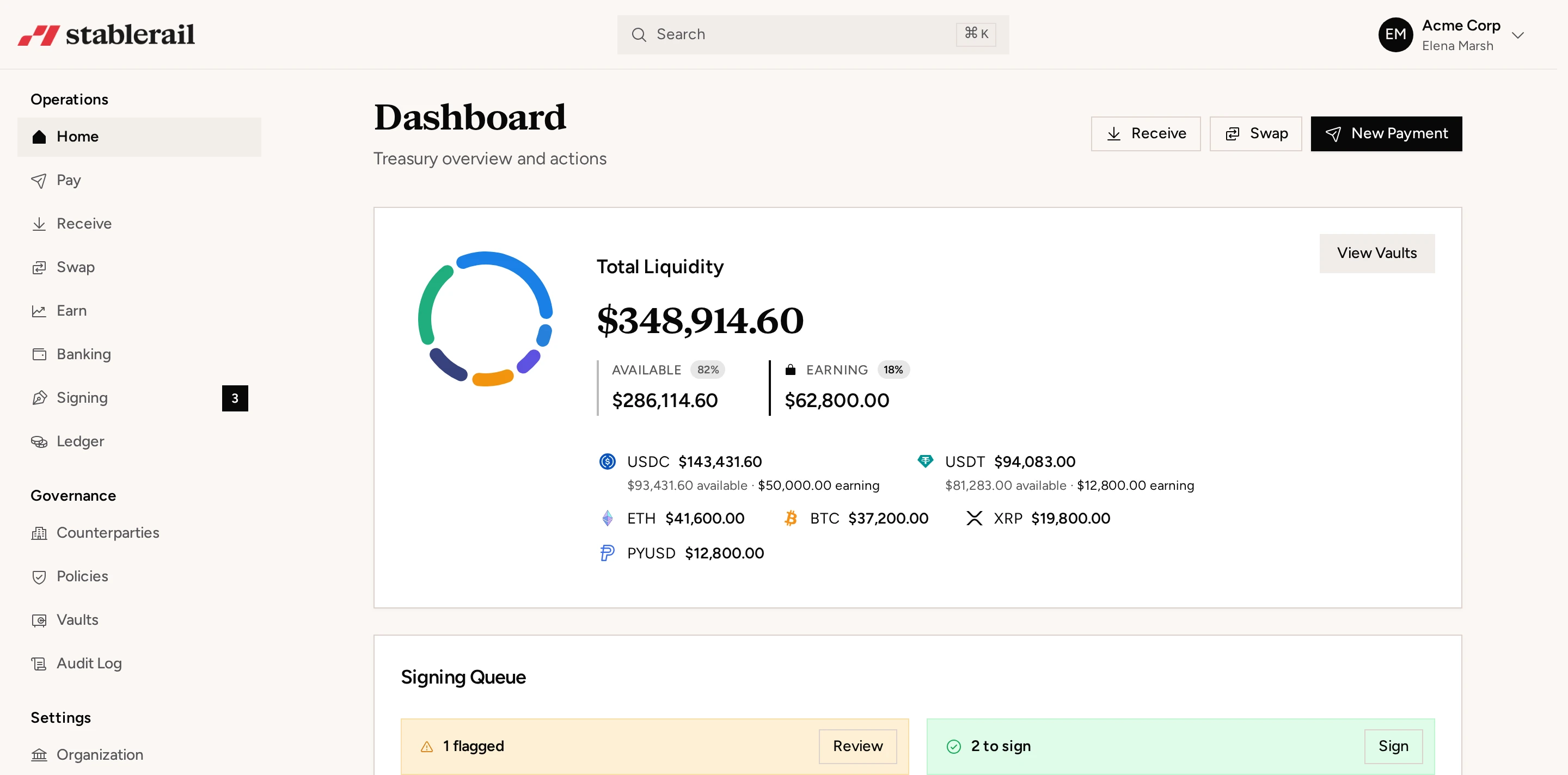
The platform is tailored for businesses managing $1M–$50M in annual stablecoin volume, with pricing adjusted based on the number of entities, active users, and transaction volume. It also includes onboarding and policy design support, helping teams adapt traditional wire transfer rules to stablecoin workflows. Through the Treasury Hub, users gain real-time visibility across balances, entities, and chains. Additionally, vendor and B2B payment modules allow for governed transfers, complete with an audit trail for every action, from payment intent to final execution.
Conclusion
A well-structured, automated governance framework can revolutionize stablecoin payment processes, especially for finance teams managing corporate treasuries. With irreversible transactions, strict liability standards, and evolving regulations like the GENIUS Act, the need for automated compliance, risk management, and operational efficiency has never been greater.
By using policy-as-code, treasury rules are transformed into machine-enforced controls. This approach ensures that unauthorized transfers are blocked, duplicate payments are avoided, and no one - not even senior leadership - can bypass safeguards. Features like pre-sign risk dossiers offer real-time verification, while automated audit trails provide the evidence regulators demand.
The operational benefits are hard to ignore. Batch payouts streamline up to 500 transfers with a single signature, 24/7 monitoring eliminates the inefficiencies of manual tracking, and smart cool-off periods - such as a 4-hour delay for transfers over $100,000 - manage risk without disrupting daily operations.
The secret lies in balancing automation with human oversight. As Stablerail explains:
"Agents verify the context. Humans sign the transaction. The system protects the treasury - it never touches the money".
This "copilot, not autopilot" approach ensures that while technology handles repetitive and routine checks, finance teams maintain control over critical decisions.
For companies managing $1M–$50M in annual stablecoin volume, a phased implementation strategy makes sense. This includes defining wallet tiers, standardizing counterparty onboarding, and integrating reconciliation data. Such a strategy combines the speed of on-chain settlement with the governance rigor of traditional banking. Stablerail’s agentic control plane bridges the gap, allowing finance teams to apply the same governance standards they rely on for bank wires while leveraging the efficiency of blockchain technology.
FAQs
What controls should happen before a stablecoin payment is signed?
Before approving a stablecoin payment, several critical controls are in place to maintain security, compliance, and proper governance. These pre-sign checks include sanctions screening, policy enforcement, anomaly detection, and counterparty risk scoring.
A detailed risk dossier is generated, which includes a verdict - either PASS, FLAG, or BLOCK - along with the reasoning behind the decision. Human approvers review this dossier to ensure all aspects are considered. This process not only helps maintain compliance and avoid mistakes but also creates a clear audit trail for every decision. All of this operates within a governance framework built on policy-as-code principles.
How can we meet AML, sanctions, and Travel Rule requirements for stablecoin transfers?
To meet AML, sanctions, and Travel Rule requirements, organizations can embed automated screening and policy enforcement directly into their payment processes. This often involves steps like:
Real-time sanctions screening to identify prohibited entities or transactions instantly.
Behavioral anomaly detection to flag unusual patterns or activities that could indicate fraud or non-compliance.
Counterparty risk scoring before signing transactions, which helps assess the potential risks associated with the involved parties.
These measures not only help ensure compliance with regulations but also minimize potential risks. On top of that, keeping detailed audit trails is crucial. These records promote transparency and accountability, while also meeting the reporting and Travel Rule obligations tied to cross-border stablecoin transfers.
How can we prove approvals and policy checks to auditors after on-chain settlement?
An audit trail is your go-to record for proving compliance to auditors. It meticulously logs every action in the process, from intent creation and checks performed to flags raised, overrides, approvals, and final signing. Each entry comes with detailed, timestamped evidence, offering transparent documentation to back up decision-making and ensure policy adherence.
Related Blog Posts
Former CEO of Simple, a self-custodial wallet with $2B+ in transaction volume across 75+ countries.
More about the Stablerail team- Stablecoin treasury managementApprovals, limits, yield and reporting on one balance.
- Stablecoin payoutsBatch contractor and vendor payments with screening.
- USDT vs USDCWhich stablecoin your company should settle in.
- Stablecoin finance glossaryMPC, off-ramp, travel rule and the rest, in plain English.
- Product updatesEverything we ship, month by month.