
5 Steps to Screen Stablecoin Exposure Risks
A five-step operating framework for screening USDC and USDT exposure: define risk rules, secure signing, screen before sending, investigate alerts and retain audit evidence.
To screen stablecoin exposure risk, define approved assets, networks and counterparties; separate wallet and signing authority; screen every destination before signing; investigate sanctions, direct and indirect exposure alerts; and retain the decision evidence with the transaction record. Apply the controls to both outgoing and incoming USDC or USDT, because an address can become risky after onboarding and blockchain transfers generally cannot be recalled.

Stablecoin exposure screening is not a one-time sanctions lookup. It is an operating process that connects counterparty due diligence, blockchain analytics, wallet controls, human approvals and accounting records. The objective is to identify unacceptable exposure before funds move, while giving finance teams a consistent way to review ambiguous alerts.
The process should cover USDC and USDT payments, treasury transfers, customer receipts, redemptions and off-ramp activity. It should also distinguish legal prohibitions from the company’s broader risk appetite. A sanctions match may require the transaction to stop, while indirect exposure to a suspicious service may require investigation rather than automatic rejection.
Step 1: Define the stablecoin exposure policy
Begin by documenting what the company is willing to hold, receive and send. The policy should specify approved stablecoins, blockchains, token contracts, wallet types and business purposes. Naming the network is essential: the same ticker can exist on several chains, and counterfeit tokens can imitate legitimate assets.
Set rules for new beneficiaries, address changes, transaction values and elevated-risk activity. Avoid treating an arbitrary number of blockchain “hops” as a universal standard. Indirect exposure is contextual: risk depends on the source category, amount, timing, flow of funds and confidence of the analytics provider.
Your written policy should answer:
- Which stablecoins, networks and official token contracts are permitted?
- Which countries, counterparties and business purposes are outside risk appetite?
- When must a destination address be screened or re-screened?
- Which findings require rejection, escalation or enhanced due diligence?
- Who can approve exceptions, and which findings cannot be overridden?
- How are inbound funds handled when screening identifies elevated exposure?
Use current sanctions sources relevant to the business. US teams can consult the OFAC sanctions compliance guidance for the virtual currency industry and the OFAC sanctions list search. Other jurisdictions maintain their own lists and requirements. Legal or compliance counsel should determine which regimes apply; blockchain analytics does not replace that assessment.
Step 2: Match wallet controls to the exposure
Screening only works if a risky transaction can be stopped before it is signed. Separate the person requesting a payment from the people approving and signing it. For material transfers, use an approval threshold or signing quorum so that one compromised account cannot move funds alone.
Segment wallets by purpose and exposure. A reserve wallet holding long-term liquidity should not share the same transaction frequency or access model as a wallet used for daily payouts. Keeping reserves, operating funds and automated balances separate limits the amount exposed if credentials, devices or workflows are compromised.
| Wallet category | Typical purpose | Appropriate controls | Screening approach |
|---|---|---|---|
| Reserve | Long-term treasury holdings | Restricted access, higher signing quorum and infrequent movement | Screen destinations before every transfer and require independent verification |
| Operating | Vendor payments, conversions and treasury movements | Role separation, transaction limits and multiple approvals | Screen each beneficiary immediately before signing |
| Payout | Higher-volume disbursements | Limited funded balance, approved batches and reconciliation | Screen recipients at onboarding and again before each batch is released |
| Collection | Receiving customer or counterparty funds | Unique deposit addresses where practical and clear hold procedures | Screen incoming transfers and escalate exposure before funds are reused |
The custody technology may be multisignature, multi-party computation or another controlled signing model. The important finance outcome is enforceable separation of duties, recoverable access and a reliable record of who authorized the exact destination, network, asset and amount.
Step 3: Screen the address before signing
Run sanctions and address screening after the transaction has been assembled but before signatures are applied. This timing matters because beneficiary records can be changed, addresses can be copied incorrectly, and risk labels can change after initial onboarding. Screening only when a vendor is created leaves a gap at the moment of payment.
A pre-send review should confirm the destination address, blockchain, official token contract, amount and expected counterparty. It should then check the address against applicable sanctions data and blockchain risk indicators. Relevant indicators can include direct interaction with a listed address and indirect exposure to categories such as stolen funds, ransomware or sanctioned services.
Screening results are not all equally certain. An exact address match to an authoritative sanctions designation differs from a model-generated risk score or indirect exposure path. Finance teams should preserve the provider’s category, confidence or severity, exposure direction, amount and transaction path rather than reducing every alert to a single opaque score.
Also verify ownership outside the blockchain analytics tool. A “clean” address does not prove that the person supplying it is the intended vendor. Confirm new or changed addresses through a previously established communication channel, not by replying to the same email that requested the change. A small test transfer may reduce addressing mistakes, but it does not replace identity verification or screening.
Apply screening to incoming funds
Outbound screening prevents the treasury from sending to an unacceptable destination. Inbound screening identifies potentially problematic receipts before the company consolidates, converts or pays those funds onward. Define whether elevated-risk receipts are held in a separate wallet, left untouched pending review or returned only after compliance approval. Automatically returning funds can create another risky transfer.
Step 4: Investigate alerts and record the decision
Convert screening output into a small number of operational outcomes. The labels can differ by system, but each outcome needs a defined action, owner and approval requirement.
| Outcome | Example basis | System action | Finance or compliance action |
|---|---|---|---|
| Pass | No relevant match under the approved policy | Release to the normal approval and signing flow | Verify transaction details and complete required approvals |
| Review | Indirect exposure, uncertain attribution or unexpected address change | Pause signing | Validate ownership, inspect the exposure path and document the conclusion |
| Reject | Confirmed prohibited destination or activity outside policy | Prevent signing | Do not send; escalate under the incident and legal process |
| Hold inbound funds | Receipt triggers an elevated-risk finding | Prevent consolidation or onward use | Investigate before moving, returning or converting the funds |
Reviewers should determine whether the alert relates to the exact address, a counterparty cluster or an indirect transaction path. They should assess how much value was exposed, when it occurred and whether the path reflects funds moving toward or away from the risky source. Attribution can change, so preserve the evidence that was available when the decision was made.
Do not allow the payment requester to clear their own alert. Exceptions should require an independent reviewer, a written rationale and any supporting evidence. A recorded override should never be used to bypass a legal prohibition.
Step 5: Preserve evidence and monitor changes
For each stablecoin transaction, retain enough information to reconstruct the request, screening result, approval and settlement. A wallet address and transaction hash alone do not explain why the payment was legitimate.
The transaction record should include:
- Business purpose, invoice or batch reference and counterparty identity.
- Asset, official token contract, network, amount and destination address.
- Screening timestamp, result, provider and relevant alert details.
- Evidence used to verify a new or changed beneficiary address.
- Requester, reviewers, signers, timestamps and any exception rationale.
- Final transaction hash, network status and accounting reconciliation reference.
Re-screen active counterparties periodically and when a new payment is prepared. Historical blockchain activity can be relabeled as investigations and sanctions designations evolve. Monitoring should therefore support an incident process: identify affected wallets, stop further movement where appropriate, preserve evidence and involve compliance or legal owners.
Test the full control chain with realistic scenarios, including an address-change request, a sanctions alert, indirect exposure, a wrong network and an unavailable approver. The test should confirm that the payment actually pauses, not merely that someone receives a notification.
Putting the five steps into operation
A finance team can begin with a narrow rollout: one approved stablecoin, one network, a defined set of counterparties and a documented escalation path. Expand only after the team can consistently screen, approve, sign and reconcile transactions without bypassing controls.
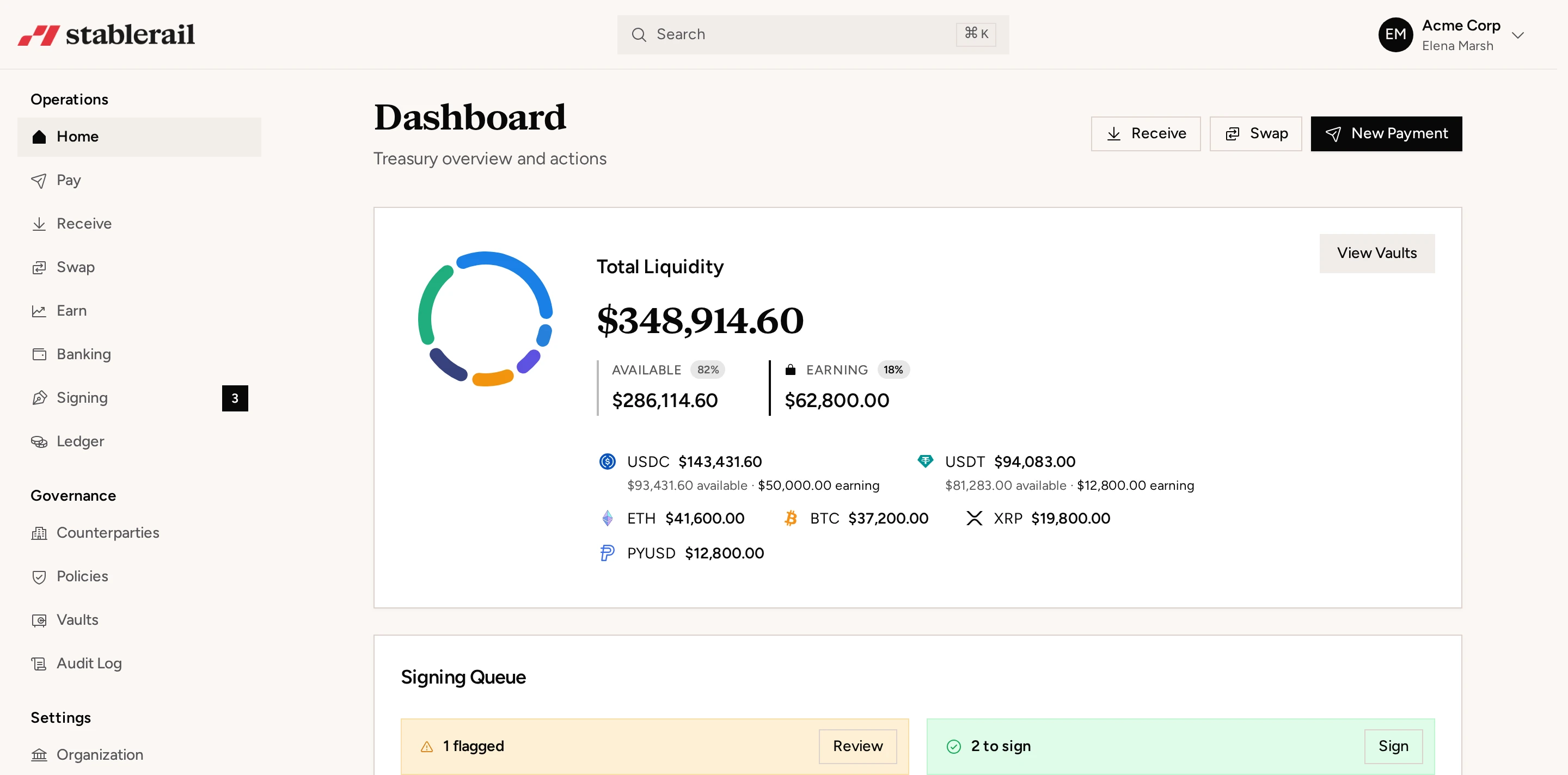
Stablerail brings USDC and USDT treasury into one business account with approvals and signing quorum, sanctions and address screening before send, global payouts, fiat off-ramp, corporate cards and exportable audit evidence. Whatever platform is used, the essential test is the same: an unacceptable transaction must be stopped before signing, while every approval and exception remains reviewable afterward.
Frequently asked questions
How do you screen a stablecoin wallet address?
Check the exact address and network against applicable sanctions data and blockchain analytics before signing. Review direct matches separately from indirect exposure, confirm the address belongs to the intended counterparty, and retain the result with the payment record.
Should stablecoin addresses be screened before every transaction?
Yes, the destination should be checked immediately before signing because risk labels, sanctions designations and beneficiary details can change. Screening at onboarding is still useful, but it should not replace transaction-time screening.
What is direct versus indirect stablecoin exposure?
Direct exposure means an address transacted directly with a identified risky or sanctioned address. Indirect exposure means funds moved through one or more intermediate addresses; its significance depends on the amount, timing, direction, source category and reliability of the attribution.
What should a company do after receiving tainted stablecoins?
Pause consolidation, conversion or onward payment until the alert has been reviewed under the company’s policy. Preserve the transaction evidence and obtain compliance or legal guidance before returning or moving funds, because an automatic return creates another blockchain transaction.
Can stablecoin sanctions screening eliminate compliance risk?
No. Screening can identify designated addresses and other on-chain risk indicators, but it cannot prove counterparty identity or detect every prohibited relationship. It should be combined with due diligence, address verification, approval controls and legal analysis of the sanctions regimes that apply.
Former CEO of Simple, a self-custodial wallet with $2B+ in transaction volume across 75+ countries.
More about the Stablerail team- Stablecoin treasury managementApprovals, limits, yield and reporting on one balance.
- Stablecoin payoutsBatch contractor and vendor payments with screening.
- USDT vs USDCWhich stablecoin your company should settle in.
- Stablecoin finance glossaryMPC, off-ramp, travel rule and the rest, in plain English.
- Product updatesEverything we ship, month by month.