
Sanctions Screening: From Intent to Execution
Pre-signature sanctions screening checks stablecoin payment intent before funds leave the wallet. Learn how to combine address intelligence, approvals, review rules, signing controls, and audit evidence.
Effective sanctions screening for stablecoin payments happens before signing, not only after settlement. Finance teams should screen recipient addresses and transaction context, route uncertain matches for review, require appropriate approvals, and bind the approved intent to the transaction that is ultimately signed. Post-transaction monitoring remains useful, but it cannot reverse an irreversible transfer. The goal is a documented control from payment intent through execution and audit evidence.

Sanctions screening for stablecoin payments should occur before a transaction is signed or broadcast. At that point, a company can still block the payment, investigate the recipient, correct the destination address, or obtain additional evidence. Screening after settlement can identify exposure and support reporting, but it cannot prevent funds from leaving. The strongest design connects payment intent, screening results, human approvals, wallet signing and post-transaction evidence in one traceable process.
Why stablecoin sanctions screening is operationally different
USDC and USDT can move around the clock across public blockchains, while blockchain transfers are generally difficult or impossible for the sender to reverse. A traditional process that reviews transactions in a daily batch may therefore produce an alert only after settlement.
Wallet addresses also do not provide the identity context found in an ordinary bank payment. An address is not, by itself, a verified legal name, jurisdiction or business purpose. Compliance teams need to combine counterparty information supplied by the business with blockchain intelligence about the address, related address clusters and the provenance of funds.
Sanctions data changes as authorities add, amend and remove designations. Some authorities publish digital asset addresses as identifiers, but screening only for exact matches to published addresses is insufficient. A sanctioned party can use additional addresses, intermediaries, exchanges, bridges or other services. Conversely, indirect contact with a risky address does not automatically prove that the current wallet owner is sanctioned.
The relevant legal test also varies by sanctions regime. Ownership, control, facilitation and indirect-benefit rules are not identical across jurisdictions. A screening provider can supply risk indicators, but the company must define which regimes apply and how those indicators affect a payment decision.
What pre-signature screening means
Pre-signature screening evaluates a proposed transaction while it is still an internal payment intent. The intent should identify the sending wallet, recipient address, blockchain, token, amount, business counterparty and payment purpose. Screening occurs before the required wallet keys or signers authorize the transfer.
This is more than adding an address-checking API immediately before broadcast. The control must prevent a user from approving one address and signing a transaction to another. The approved intent should therefore be bound to the executable transaction details, including the destination, asset, network and amount. Any material change should invalidate the prior approval and trigger fresh screening.
| Stage | Control | Primary outcome | Evidence to retain |
|---|---|---|---|
| Payment creation | Capture counterparty, address, network, asset, amount and purpose | Complete payment intent | Requestor, timestamp and source documents |
| Pre-signature screening | Check sanctions indicators, attribution, exposure and relevant transaction context | Approve, reject or hold for review | Provider response, list or dataset version, risk indicators and decision |
| Review and approval | Apply escalation rules and approval thresholds | Documented authorization or rejection | Reviewer identity, rationale, attachments and timestamps |
| Signing and broadcast | Confirm the signed transaction matches the approved intent and signing quorum | Authorized transaction submitted | Final payload, signer records and transaction hash |
| Post-transaction monitoring | Monitor settlement status and later intelligence changes | Operational follow-up or escalation | Confirmations, monitoring alerts and case records |
How the screening decision should work
1. Exact sanctions identifiers
The first layer checks whether the sending or receiving address appears as an identifier in the sanctions data relevant to the company. List ingestion should be monitored so that a failed or stale update cannot silently leave the payment process using obsolete data. The screening record should identify the data source and version or retrieval time used for the decision.
2. Address attribution and clusters
Blockchain analytics providers associate addresses with services, entities and address clusters using different methods and confidence levels. A cluster-level link can reveal risk that an exact-address comparison misses, but it also requires careful interpretation. Finance teams should know whether an alert is based on a published identifier, provider attribution, inferred common ownership or transactional exposure.
3. Direct and indirect exposure
Exposure analysis examines whether funds came from or moved through an address associated with a sanctioned actor or another prohibited category. A simple rule based on a fixed number of transaction hops can be misleading: it may miss obfuscation or generate alerts for remote, economically insignificant contact.
A defensible process considers direction, value, recency, intermediary type and the quality of the underlying attribution. Funds passing through a large pooled service, for example, may require different analysis from a direct transfer from a designated address. The screening tool should expose enough detail for a reviewer to understand why an alert occurred.
4. Cross-chain activity
Risk does not disappear when value moves through a bridge, centralized exchange or decentralized exchange. If cross-chain provenance is available, the review should preserve the connection between the source transaction, the conversion or bridge event and the destination chain. Where visibility breaks, the correct response may be additional counterparty evidence or enhanced review rather than an unsupported assumption that the funds are clean.
5. Transaction and counterparty context
The same address signal can lead to different operational responses depending on the payment. Relevant context includes the counterparty's legal identity, jurisdiction, purpose, expected activity, prior payment history, asset, network and amount. These factors do not override a confirmed sanctions prohibition, but they help reviewers investigate ambiguous analytics alerts and document why a payment was released or blocked.
Use explicit decision outcomes
A binary pass-or-fail result is rarely enough. Finance and compliance should agree on a small set of outcomes that the payment system can enforce consistently.
| Outcome | When to use it | Execution rule |
|---|---|---|
| Approve | No relevant match or alert under the documented threshold | Continue to required business and treasury approvals |
| Hold | Possible match, uncertain attribution or missing context | Prevent signing until review is completed |
| Reject | Confirmed prohibited destination or unacceptable risk under company rules | Do not sign or broadcast; preserve the case record |
| Request information | Counterparty identity, ownership, wallet control or payment purpose is unclear | Keep payment blocked while evidence is collected |
| Escalate | Legal interpretation, reporting duties or potential asset blocking requires specialist input | Restrict action to authorized compliance or legal personnel |
Escalation procedures should identify who can release a hold, who can reject a payment and when legal counsel must be involved. They should also address what happens if a sanctions data source or screening service is unavailable. Allowing every payment to proceed during an outage defeats the preventive control; stopping every payment indefinitely may create unacceptable operational risk. The fallback must be chosen, approved and tested in advance.
Connect screening to wallet authorization
Screening is ineffective if a user can bypass it by sending directly from an unmanaged wallet. Stablecoin treasury controls should limit which wallets may execute corporate payments, separate requestors from approvers where practical, and require an appropriate signing quorum for material transfers.
Approval thresholds can reflect amount, destination novelty and risk. A first payment to a new address may require address verification and additional approval, while a recurring payment to a previously approved address can use a streamlined workflow—but it should still be screened against current information before execution. Address allowlists are operational aids, not permanent sanctions clearance.
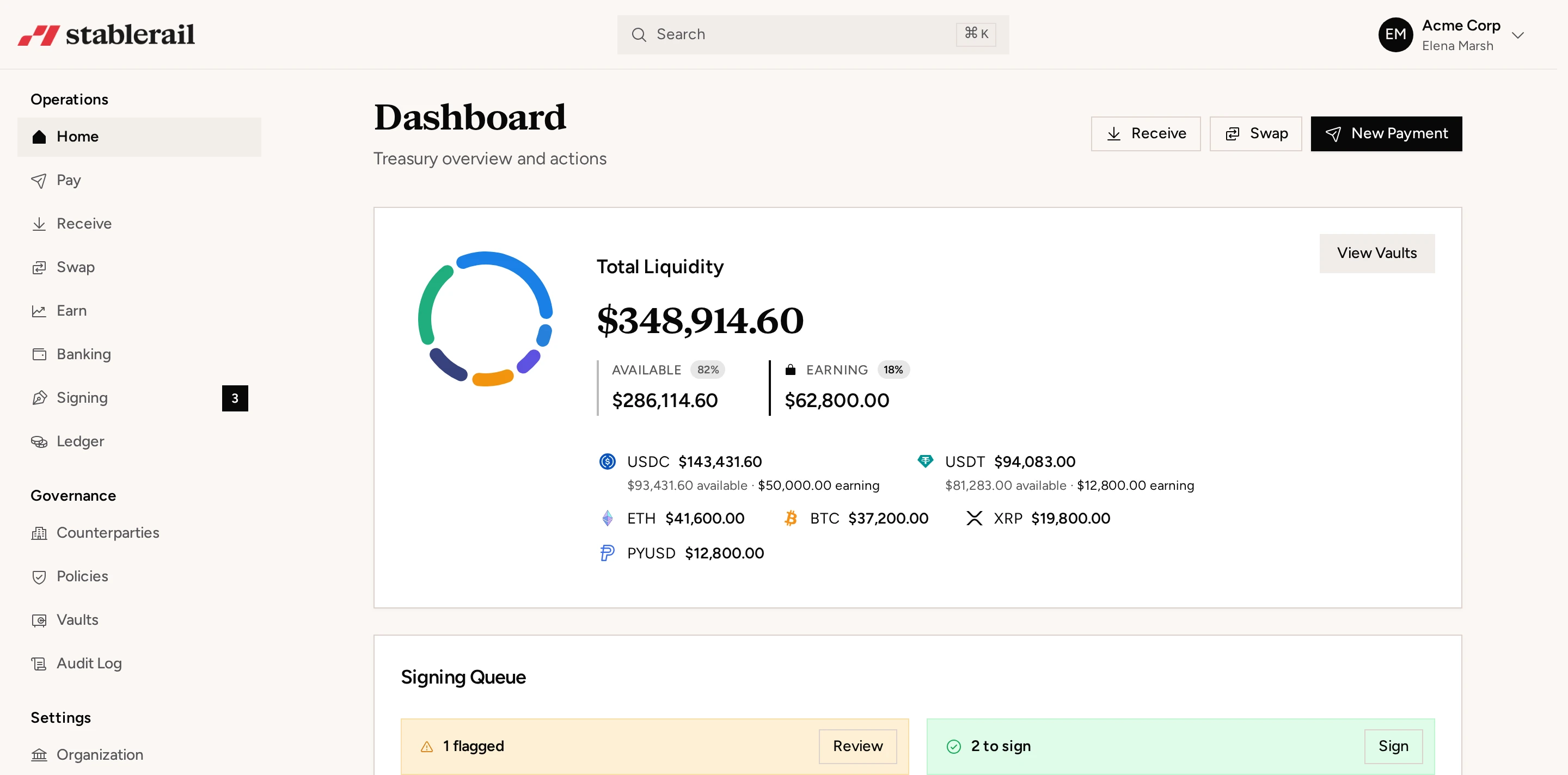
Stablerail brings USDC and USDT treasury activity into one business account with approvals and signing quorum, sanctions and address screening before send, corporate cards, global payouts, fiat off-ramp and exportable audit evidence. Whatever platform is used, the essential control is that screening and authorization sit in the execution path rather than in a disconnected spreadsheet or after-the-fact review.
Build evidence an auditor can reconstruct
An audit-ready record should show what the company knew and decided at the time of payment. Retain the payment request, counterparty details, exact address and network, screening response, applicable data timestamp, alert details, reviewer notes, approval records, signed transaction details and on-chain transaction hash. Access to case records should be restricted, and later edits should be attributable.
Teams should also measure control performance. Useful measures include the share of payments screened before signing, review volume, time spent resolving holds, reasons for overrides or releases, failed data updates and attempts to bypass the approved workflow. A rising alert count is not automatically better compliance; it may indicate overly broad thresholds that consume reviewer attention without improving decisions.
Implementation checklist for finance teams
- Map applicable regimes: document the sanctions jurisdictions, ownership and control rules, and internal risk standards relevant to the business.
- Define the payment intent: require recipient address, blockchain, token, amount, counterparty and business purpose before review.
- Choose screening inputs: combine official sanctions data with clearly understood blockchain attribution and exposure indicators.
- Set decision rules: define approve, hold, reject, information-request and escalation outcomes, including outage handling.
- Bind approval to execution: invalidate screening and approvals if the address, network, asset or amount changes materially.
- Control signing: use role separation, transaction limits and signing quorum appropriate to treasury risk.
- Retain evidence: connect the screening result and reviewer decision to the final transaction hash.
- Test the workflow: verify that stale data, unavailable services, changed addresses and unauthorized wallets cannot bypass controls.
Pre-signature screening is necessary, but not sufficient
No screening system can guarantee that every address is correctly attributed or that new intelligence will be available before a payment. Pre-signature controls reduce preventable exposure by creating a decision point before value moves. Post-transaction monitoring still matters because an address may be designated later, an attribution may change, or a transaction pattern may only become clear over time.
The practical objective is not an alert on every blockchain connection. It is a repeatable process that identifies relevant risk, gives qualified reviewers enough context to decide, prevents unapproved execution and preserves evidence. For stablecoin treasury teams, moving sanctions screening from post-payment observation into the signing path is the critical shift from compliance intent to operational control.
Frequently asked questions
What is pre-signature sanctions screening for stablecoins?
Pre-signature screening checks a proposed stablecoin transaction before the wallet signs or broadcasts it. It gives the company time to approve, hold, reject or investigate the payment while funds are still under its control.
Is checking a wallet address against the OFAC list enough?
No. Exact matching can identify published digital currency addresses, but sanctioned parties may use additional wallets, intermediaries or cross-chain routes. A stronger process combines official sanctions data with address attribution, exposure analysis and verified counterparty context.
How often should stablecoin addresses be screened?
Screen the address using current information immediately before authorization or signing, even if it was approved previously. Material changes to the address, network, asset or payment details should trigger a new check and fresh approval.
What should happen when a sanctions screening tool flags an address?
The payment should be held before signing and routed to an authorized reviewer. The reviewer should examine the alert basis, attribution confidence, transaction path, counterparty identity and applicable legal rules, then document whether the payment is rejected, escalated or released.
Does post-transaction monitoring replace pre-signature screening?
No. Post-transaction monitoring can detect later designations, changed attribution and developing transaction patterns, but it cannot prevent a completed transfer. Finance teams generally need both preventive screening before signing and continuing monitoring after settlement.
What evidence should be retained for a stablecoin sanctions check?
Retain the payment intent, recipient address and network, screening result, data timestamp, alert details, reviewer rationale, approvals, signed transaction details and transaction hash. The record should allow an auditor to connect the compliance decision to the transaction that was actually executed.
Former CEO of Simple, a self-custodial wallet with $2B+ in transaction volume across 75+ countries.
More about the Stablerail team- Stablecoin treasury managementApprovals, limits, yield and reporting on one balance.
- Stablecoin payoutsBatch contractor and vendor payments with screening.
- USDT vs USDCWhich stablecoin your company should settle in.
- Stablecoin finance glossaryMPC, off-ramp, travel rule and the rest, in plain English.
- Product updatesEverything we ship, month by month.