
Real-Time Reconciliation with Stablecoins: Guide
A practical guide to reconciling USDC and USDT payments with invoices, counterparties and general ledger entries as blockchain events occur.
Real-time stablecoin reconciliation links each USDC or USDT transfer to its invoice, counterparty, approval record and general ledger entry as blockchain events are confirmed. It requires structured payment references, reliable chain data, controlled signing, deterministic matching rules and an exception queue. The goal is not zero human involvement, but continuous posting of clean transactions while routing ambiguous, failed or high-risk activity to finance for review.

Real-time reconciliation turns a blockchain transfer into an accounting-ready record as soon as the required confirmation threshold is reached. Instead of comparing wallet exports with invoices at month-end, finance receives a continuous record containing the asset, network, amount, transaction hash, counterparty, business purpose, approvals and supporting evidence.
“Real time” does not mean every transaction is posted instantly or without review. Blockchain confirmation, data-provider latency, ERP integration schedules and exception handling all affect timing. A defensible process automatically posts transactions that satisfy clear matching rules and holds uncertain items for investigation.
What stablecoin reconciliation must connect
A blockchain records that an address transferred a token to another address. It does not inherently know whether the transfer paid an invoice, funded a subsidiary, refunded a customer or moved treasury assets between company-controlled wallets. Reconciliation supplies that missing business context.
For each USDC or USDT movement, the process should connect four layers:
- On-chain evidence: transaction hash, network, token contract, sending and receiving addresses, raw token amount, block number, timestamp, status and network fee.
- Business evidence: invoice number, purchase order, payroll batch, customer account, settlement report or intercompany reference.
- Control evidence: requester, approvers, signers, timestamps, screening result and any override rationale.
- Accounting result: legal entity, general ledger accounts, accounting date, functional-currency value and posting status.
The transaction hash is an important identifier, but it is not a sufficient accounting reference by itself. Finance also needs the correct blockchain network because similar-looking addresses and the same ticker can appear across multiple chains.
Prerequisites for continuous reconciliation
The strongest setup captures business context before funds move. Trying to infer invoice references from blockchain activity after execution creates avoidable ambiguity.
| Capability | Minimum requirement | Control objective |
|---|---|---|
| Payment intake | Entity, counterparty, purpose, asset, network, amount and business reference | Give every transfer an accounting identity before execution |
| Wallet controls | Named users, approvals, signing quorum and access reviews | Prevent one person from requesting and completing an uncontrolled payment |
| Address controls | Validated network, beneficiary ownership evidence and sanctions/address screening before send | Reduce wrong-network, wrong-address and compliance risk |
| Chain data | Token transfer events, native network fees, confirmation status and reorg handling | Record what settled rather than relying only on a wallet interface |
| Accounting integration | Chart-of-accounts mapping, entity rules, valuation source and idempotent posting | Create consistent entries without duplicates |
| Exception management | Owner, reason code, evidence, resolution and aging | Ensure unmatched items are investigated and closed |
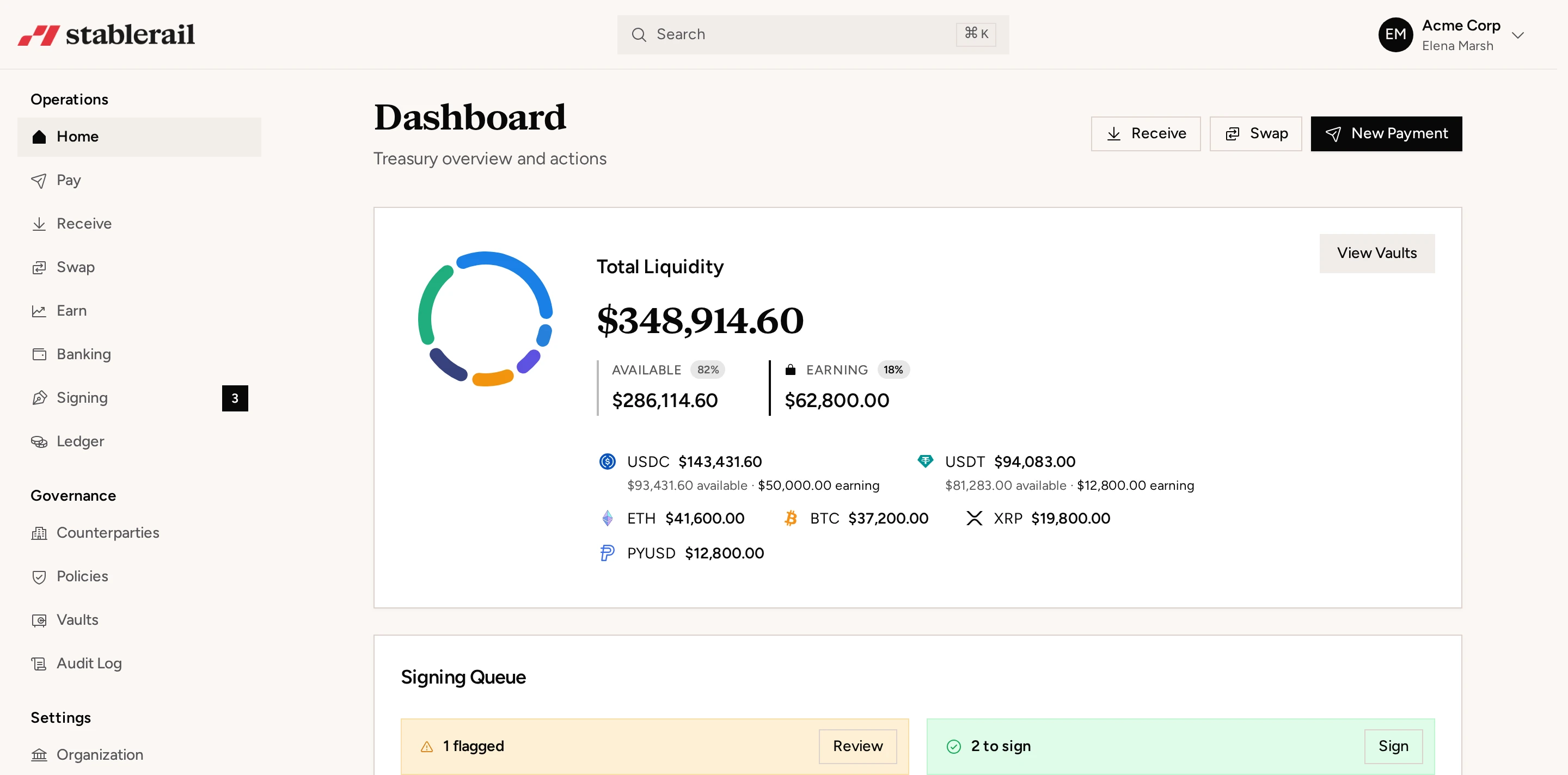
A centralized treasury workspace can bring these elements together. For example, Stablerail provides a business account for USDC and USDT treasury with approvals and signing quorum, pre-send sanctions/address screening, global payouts, fiat off-ramp and exportable audit evidence.
Step-by-step stablecoin reconciliation process
1. Create a structured payment intent
Start with a payment record rather than a bare wallet transfer. The record should identify the paying entity, beneficiary, invoice or batch reference, stablecoin, network, destination address and expected amount. Attach the invoice, settlement statement or other source document.
Assign an internal payment ID that remains unchanged through approval, signing, settlement and ledger posting. This becomes the primary link between operational and accounting systems.
2. Validate the payment before signing
Confirm that the token is supported on the selected network and that the destination address belongs to the intended counterparty. Screen the address before sending, check approval requirements and verify that the wallet holds enough of the network’s native asset to pay gas where applicable.
Separate payment initiation from approval or signing. Higher-value, new-beneficiary or unusual transfers may justify additional approvers, but thresholds should reflect the company’s own risk assessment rather than a generic universal limit. Overrides should identify who approved the exception, when and why.
3. Sign and broadcast the transaction
After approval, authorized signers create and broadcast the transaction. Record the signer identities, signing time, originating wallet, destination, asset, network and transaction hash. A signing quorum or distributed key-control arrangement can reduce reliance on a single person or credential.
Do not mark the invoice paid merely because the transaction was submitted. A broadcast transaction can remain pending, be replaced or fail. Payment status should progress through defined states such as approved, signed, broadcast, confirmed, posted or exception.
4. Ingest confirmed blockchain events
A chain-data service should monitor company-controlled addresses and relevant token contracts. It must capture token transfers separately from native-asset movements so that the stablecoin amount and network fee are not confused.
Set a documented confirmation policy for each supported network. The appropriate threshold depends on network characteristics and the company’s risk tolerance. The integration should also handle reorganizations by reversing or withholding records when a previously observed event is no longer canonical.
5. Match the event to business records
The preferred match uses the internal payment ID associated with the transaction hash. Secondary rules can compare entity, wallet, destination, token contract, network and exact raw token amount. Amount comparisons must respect the token contract’s decimal precision rather than rounded values displayed in an interface.
| Observed result | Reconciliation treatment | Finance action |
|---|---|---|
| Reference, network, asset, address and amount all agree | Auto-match after required confirmations | Post under the approved accounting mapping |
| Correct counterparty but amount differs | Place in exception | Check partial payment, fee deduction, duplicate invoice or data-entry error |
| Known internal source and destination wallets | Classify as treasury transfer | Move value between wallet accounts; do not record an expense |
| Inbound transfer has no customer or invoice reference | Hold as unidentified receipt | Obtain remittance evidence before clearing receivables |
| Transaction failed or was replaced | Do not settle the payable | Record any incurred network fee and link the replacement transaction |
| Asset or network does not match the intent | Block automatic posting | Investigate operational error and recovery options |
6. Create the accounting entry
Accounting treatment depends on the transaction’s purpose, not simply the fact that a stablecoin moved. A vendor payment may debit accounts payable and credit the relevant stablecoin wallet account. A receipt may debit the wallet account and credit accounts receivable or an unidentified-receipts clearing account. A transfer between company-controlled wallets generally reallocates balances rather than creating revenue or expense.
Network fees usually require a separate line because they may be paid in a native asset such as ETH even when the principal is USDC or USDT. The system should capture the fee asset, quantity and valuation rather than subtracting it from the stablecoin amount.
Finance should document how stablecoins are classified and valued under its applicable accounting framework. The reconciliation record should preserve both token units and the functional-currency amount, together with the valuation source and timestamp. Redemptions and fiat off-ramps also need separate records for the stablecoin disposal, provider fees, bank receipt and any difference arising from timing or pricing.
7. Post once and retain evidence
ERP integrations should be idempotent: resending the same confirmed event must not create a duplicate journal. A practical control is to enforce uniqueness using a combination of network, transaction hash and event or log index, because one blockchain transaction can contain multiple token-transfer events.
Retain the payment request, supporting document, approvals, screening result, transaction details, matching result, journal identifier and exception history. This creates a traceable path from invoice to approval, blockchain settlement and ledger entry.
How to manage exceptions without losing speed
Real-time reconciliation succeeds when clean transactions flow automatically and exceptions remain visible. It fails when unmatched entries accumulate in a spreadsheet outside the controlled process.
Use reason codes such as missing reference, amount mismatch, unknown address, wrong network, failed transaction, duplicate event or valuation unavailable. Assign an owner and target review date to each exception. Material unresolved items should appear in close reporting and wallet-to-ledger reconciliations.
Finance should still perform a periodic control reconciliation comparing independently sourced on-chain balances with ledger balances by entity, network, token contract and wallet. Continuous matching improves timeliness, but it does not eliminate the need to prove completeness at period-end.
Implementation checklist for finance teams
- Inventory every legal entity, wallet, stablecoin, token contract and supported network.
- Define mandatory payment fields and a persistent internal reference.
- Document requester, approver and signer responsibilities.
- Set confirmation, replacement and blockchain-reorganization rules by network.
- Map payment types, fees, internal transfers, receipts and redemptions to ledger accounts.
- Build exact-match rules before adding tolerance-based matching.
- Create exception reason codes, owners and aging reports.
- Test duplicate events, partial payments, failed transfers and unsupported assets.
- Verify that exports reproduce the full evidence trail for auditors.
- Reconcile wallet balances independently at each reporting close.
Measures that show whether the process works
Track the percentage of confirmed events matched without intervention, confirmation-to-posting time, number and age of exceptions, duplicate-posting attempts prevented and wallet-to-ledger differences. Measure failed and wrong-destination attempts separately from accounting exceptions so operational risk is not hidden inside a general reconciliation metric.
The objective is a controlled chain from business intent to ledger entry. When references are captured before signing, settlement data is complete and exceptions have accountable owners, stablecoin reconciliation can operate continuously while remaining reviewable at close.
Frequently asked questions
How do you reconcile stablecoin transactions in an ERP?
Create a payment record with an internal reference before execution, then link that reference to the blockchain transaction hash after broadcast. Once the transfer reaches the required confirmation threshold, match the network, token contract, addresses and raw amount before sending an idempotent journal to the ERP.
Can USDC and USDT transactions be reconciled in real time?
Yes, clean transactions can be matched and prepared for posting as blockchain events are confirmed. Actual timing depends on network confirmations, chain-data latency, ERP integration frequency and whether the transaction enters an exception workflow.
What information is needed to reconcile a blockchain payment?
Finance needs the network, token contract, transaction hash, event index, addresses, raw token amount, timestamp, status and network fee. It also needs business context such as the entity, counterparty, invoice or batch reference, approvals and accounting purpose.
How should network fees be recorded for stablecoin payments?
Record the network fee separately from the stablecoin principal because it may be paid in a different native asset. Preserve the fee quantity, asset and functional-currency valuation, then post it according to the company’s documented accounting policy.
Does real-time reconciliation replace month-end wallet reconciliation?
No. Continuous reconciliation reduces unmatched activity and makes close faster, but finance should still compare independently sourced on-chain balances with ledger balances at period-end. That control tests completeness across wallets, networks and token contracts.
Former CEO of Simple, a self-custodial wallet with $2B+ in transaction volume across 75+ countries.
More about the Stablerail team- Stablecoin treasury managementApprovals, limits, yield and reporting on one balance.
- Stablecoin payoutsBatch contractor and vendor payments with screening.
- USDT vs USDCWhich stablecoin your company should settle in.
- Stablecoin finance glossaryMPC, off-ramp, travel rule and the rest, in plain English.
- Product updatesEverything we ship, month by month.