
How Real-Time Compliance Works in Stablecoin Payments
Pre-sign, automated compliance transforms instant stablecoin payments into auditable, bank-grade transactions without slowing settlement.

Stablecoin payments settle in seconds, making them fast but irreversible. This creates a challenge: compliance checks must happen before transactions are signed, not after. Real-time compliance ensures that every payment is screened for sanctions, policy rules, and risks instantly - without slowing down the process.
Key points:
Pre-Sign Checks: Transactions are verified against sanctions lists, blockchain histories, and internal policies before signing.
Policy Enforcement: Automated rules (like spending limits or approval requirements) ensure governance.
Anomaly Detection: Identifies unusual patterns, like large payments at odd hours, to flag potential risks.
Audit Trails: Every decision is logged with timestamps and policy references for transparency.
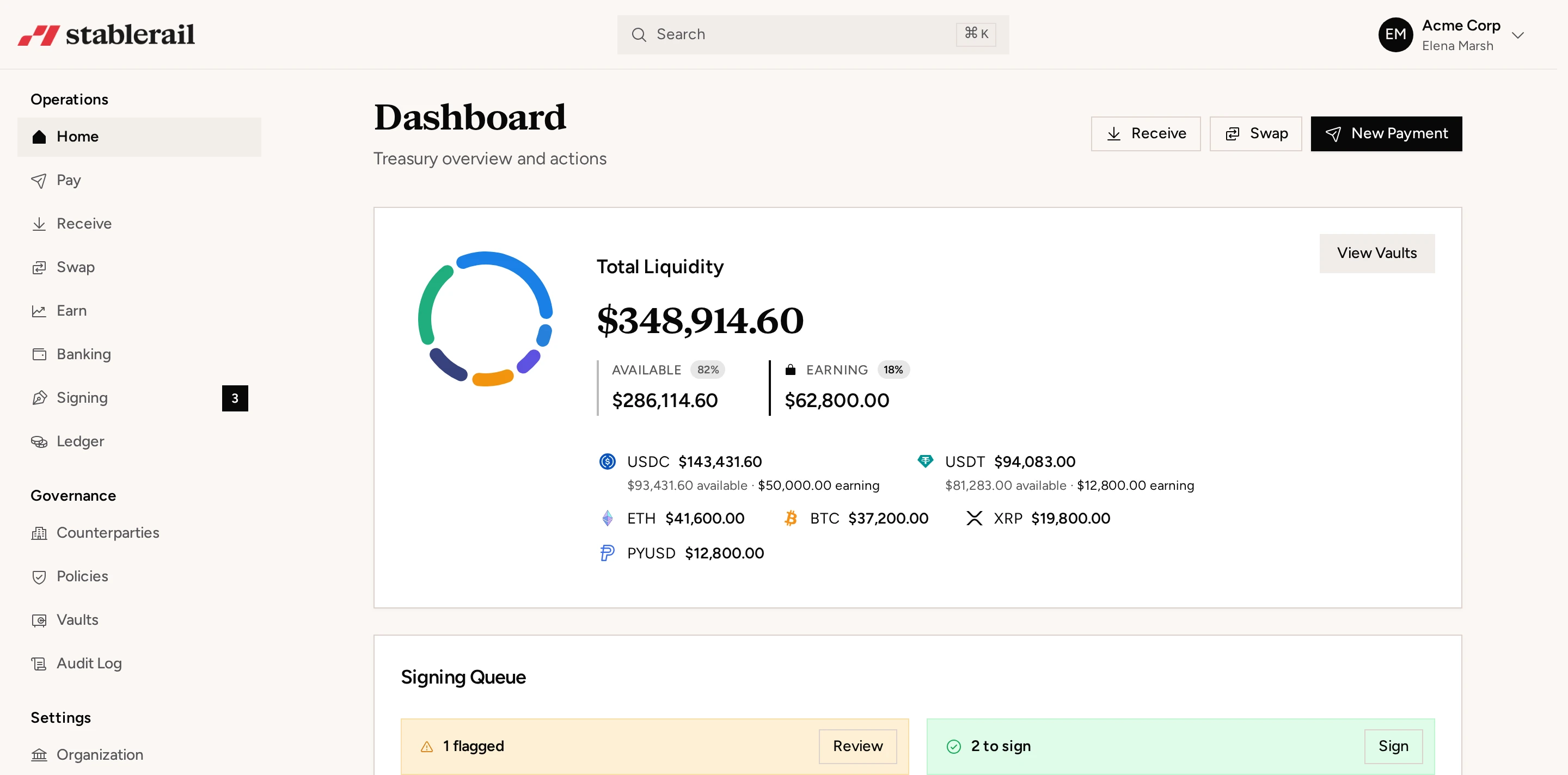
Stablerail enables this by acting as a compliance layer that validates payments without holding your funds. It integrates with self-custodial wallets, ensuring your organization remains in control while maintaining strict oversight of every transaction.
Stablecoin Issuance With CRE | Convergence Hackathon
How Real-Time Compliance Validation Works
Real-Time Stablecoin Compliance Validation Process Flow
Real-time compliance validation operates through three tightly integrated layers, ensuring that stablecoin transactions meet all necessary checks before they hit the blockchain. Unlike traditional wire transfers, which take days and allow for post-transaction reviews, stablecoin payments settle in seconds. This rapid pace demands compliance checks to occur instantaneously - before the transaction is even signed and shared with the network.
The process kicks off as soon as a payment intent is created. Whether it’s from an invoice PDF, a vendor payout CSV, or an API call, the system begins its work. Specialized agents perform sanctions checks and screen for illicit activity by analyzing the recipient's wallet address and its transaction history against global watchlists. Simultaneously, policy-as-code rules assess whether the transaction aligns with governance requirements like spending limits, approval workflows, or restrictions on specific blockchains and stablecoins. To add another layer of security, behavioral anomaly detection compares the transaction against historical patterns, looking for unusual timing, amounts, or recipient activity that might signal fraud. All these layers come together to produce a unified Risk Dossier, delivering a clear outcome - PASS, FLAG, or BLOCK - along with detailed explanations tied to timestamps and policy rules. This entire process happens in seconds, preserving the speed of stablecoin payments while maintaining strict oversight.
Pre-Sign Checks and Risk Screening
Before a transaction even enters the mempool, pre-sign checks scan the recipient wallets and transaction details against various risk databases. These checks include:
Sanctions Screening: Verifying individuals, entities, locations, and wallet addresses against regulatory watchlists.
Taint Checks: Analyzing blockchain history to identify connections to mixers, ransomware payments, or other illicit activities.
For instance, blockchain intelligence tools monitor ongoing wallet activity, while integrated KYC/AML solutions confirm identities directly within the payment flow. These checks also assess counterparty risks by examining the recipient wallet's transaction history, age, and ties to high-risk jurisdictions. For example, a USDC transfer on Ethereum might be blocked if the recipient has interacted with a sanctioned entity or if geolocation data shows the payment originates from a restricted region.
Traditional compliance models, which rely on post-settlement reviews, fall short here. Stablecoins settle within seconds, leaving no room for reversing suspicious transactions. Inline validation is the only viable solution. Regulatory frameworks like the EU's Instant Payment Regulation, which mandates a 10-second settlement window and imposes penalties of up to €100 million for compliance failures, underscore the importance of pre-sign checks.
Policy Enforcement with Policy-as-Code
Policy-as-code transforms governance rules into automated logic that runs before a transaction is signed. Finance teams define these rules through a policy console, setting conditions like "Payments over $5,000 to new addresses require CFO approval" or "Only allow USDC on Base or Ethereum". These policies automatically evaluate transaction details such as amounts, recipient addresses, blockchain networks, and time-of-day restrictions.
Policy Type
Trigger Condition
Automated Outcome
New Address Verification
Payment > $5,000 to a non-whitelisted address
Halt transaction pending CFO approval
Weekend/Off-Hours Rule
Transfer > $10,000 requested at 2:00 AM Saturday
Step-up verification or mandatory delay
Address Hygiene
Change detected in "Golden Source" vendor address
Automatic account lock and escalation
Velocity Control
Spending spike deviates from historical baseline
Flag for manual review/hold transaction
For example, if a vendor payout CSV triggers a policy, the system generates a Risk Dossier with a verdict (PASS/FLAG/BLOCK) and a detailed explanation. A flagged transaction might show: "BLOCKED: Payment to 0x742d... exceeds $10,000 weekend limit (Policy 3.2.1, triggered 03/31/2026 11:47 PM EST)." This prevents the transaction from proceeding until approvals are secured, replicating the governance controls of traditional banking without compromising blockchain speed.
Policy-as-code also supports role-based access control (RBAC). Junior staff can initiate payment requests, but Only authorized signers can approve and execute them, often managed through MPC wallets for treasury operations. This creates a formal, auditable approval process, replacing informal methods like Slack messages or emails.
Anomaly Detection in Transactions
While policy enforcement ensures compliance with rules, anomaly detection focuses on spotting irregular behavior. The system builds a baseline for normal transaction activity - such as typical payment amounts, time-of-day patterns, and payout frequencies - and flags deviations. For instance, a sudden large USDT transfer at 3:00 AM from a wallet that typically operates during business hours would raise an alert.
The system uses blockchain transparency to trace funds across multiple hops, identifying attempts to obscure the origin of funds through intermediary wallets. For example, it can flag money laundering patterns like rapid wallet creation or unusual transaction volumes. When anomalies are detected, the system may impose a temporary cool-off period - usually a four-hour delay for high-risk transactions - to allow for manual review. In more serious cases, such as a modified vendor address in the "Golden Source" whitelist, the system automatically locks the account and requires documented overrides before releasing funds.
Every action, along with its reasoning, is logged in an immutable audit trail, providing clear evidence for regulators, auditors, and boards. By combining timing analysis, recipient tracking, and velocity monitoring, anomaly detection ensures a robust defense tailored to the instant-settlement nature of stablecoin payments, reducing risks while maintaining strict governance.
How Stablerail Enables Real-Time Compliance
Real-time compliance hinges on pre-sign checks and policy rules, and Stablerail brings these to life through its layered control structure. Acting as an agentic control plane, Stablerail validates every transaction before signing. Unlike traditional custody platforms that mostly focus on key management, Stablerail operates as "the brain on top", safeguarding the business decision layer instead of just the cryptographic keys. This approach fills a critical gap: while custody tools are excellent at securing keys, they lack visibility into essential business details like invoice data, vendor history, or the reasoning behind policies. By embedding itself in the transaction decision process, Stablerail enables finance teams to apply governance standards akin to bank wires to stablecoin payments - all while retaining the speed of on-chain settlement.
Stablerail ensures compliance by validating context and enforcing policies, while leaving control of funds with your MPC-based wallets. This "copilot, not autopilot" approach guarantees that compliance checks happen in real time. Below, we explore how Stablerail enforces compliance while maintaining swift transaction processing.
Self-Custodial Framework for Secure Payments
Stablerail's self-custodial framework ensures that finance teams retain full control over funds without granting the platform any signing authority. Funds are stored in MPC-based wallets across major EVM chains, with support for Solana coming soon, and handle USDC and USDT stablecoins. Since Stablerail lacks unilateral signing power, only authorized personnel can initiate transfers. This design eliminates the risk of a compromised platform moving funds without permission, as the signing authority remains firmly within the organization’s MPC infrastructure.
This architecture directly addresses a major concern for finance teams transitioning from traditional banking to stablecoin payments. While typical custody platforms focus on managing keys, they often require some level of trust in a third party for fund access. Stablerail’s model mirrors the control structure used in traditional bank accounts - where the bank facilitates transactions but cannot independently move funds - while adding a governance layer that ensures every payment aligns with business policies before approval.
Pre-Sign Verification Process
When a payment is initiated, specialized agents conduct pre-sign checks and compile a Risk Dossier. This dossier delivers a clear outcome - PASS, FLAG, or BLOCK - along with detailed supporting evidence. Agents perform tasks such as sanctions screening, taint analysis, policy enforcement, behavioral anomaly detection, and counterparty risk evaluation. The results are then organized into a narrative that references specific policies and includes timestamps.
For instance, a flagged transaction might display:
"BLOCKED: Payment to 0x742d... exceeds $10,000 weekend limit (Policy 3.2.1, triggered 03/31/2026 11:47 PM EST)."
This process transforms compliance from a simple yes-or-no decision into an informed governance system. Approvers can clearly see why a transaction was flagged and which policies were triggered. The Risk Dossier provides CFO-level documentation that satisfies auditors, boards, and regulators - making it particularly useful for organizations managing $1 million to $50 million in stablecoin transactions annually.
Human Approval Workflow
After automated checks, the final step incorporates human oversight before the transaction is executed. If a transaction receives a PASS verdict, Stablerail allows for one-click execution using the "Approve & Sign" feature. For flagged transactions, the system locks the payment until a human reviewer steps in to provide an explicit, recorded reason for any override. This human-in-the-loop workflow balances speed with accountability, using role-based access controls to clearly separate the roles of requesters, preparers, approvers, and signers.
Audit Trails and Governance Controls
Complete Audit Trails
Stablerail meticulously tracks every step of a transaction, starting from the creation of a payment intent to the final Multi-Party Computation (MPC) signing. Each transaction generates an unchangeable log that details everything: transaction intent, pre-sign checks (like sanctions screening, policy enforcement, and taint analysis (often quantified using a stablecoin risk calculator)), any flags or overrides (with documented reasons), approvals, and the final signing. These logs are not just technical - they include timestamped, plain-English explanations that reference specific policy clauses, providing clear, CFO-level evidence.
"Every payout generates a defensible receipt: what was paid, why, who approved, and the risk verdict." - Stablerail
This level of documentation fills a gap often left by traditional custody platforms. While these platforms are proficient at securing cryptographic keys, they typically don’t offer visibility into the broader business context - like the invoice that triggered a payment, the vendor’s history, or the policy reasoning behind an approval. Stablerail goes beyond by capturing this business layer, turning compliance into a robust governance record. For companies managing $1 million to $50 million annually in stablecoin transactions, this eliminates the outdated reliance on wallets, spreadsheets, and Slack for record-keeping. Instead, Stablerail delivers audit-ready documentation aligned with U.S. regulatory standards, including OFAC sanctions compliance for stablecoins like USDC and USDT. This comprehensive logging ensures that every transaction decision is fully traceable in real time.
Role-Based Access and Approval Controls
Stablerail doesn’t just stop at audit trails; it also enforces strict access controls to protect every transaction. Through its Policy Console, governance is maintained using role-based permissions and multi-level approval workflows. Finance teams can assign roles that separate responsibilities - such as payment requesters, preparers, approvers, and signers - ensuring that no single person has unchecked control over funds. Policies, such as requiring CFO approval for payments over $5,000 to new addresses, are translated into automated, role-specific steps.
MPC technology ensures funds remain locked until all necessary approvals are completed. Every action, including any policy overrides, is logged with details like the approver’s identity, a timestamp, and the documented reason. This produces a verifiable Proof-of-Control record that clearly shows who authorized what, when, and why. With over 70% of businesses using stablecoins prioritizing automated compliance, Stablerail’s role-based controls meet this need by enforcing least-privilege access and maintaining a clear separation of duties at the transaction level.
Core Compliance Modules
All these controls are part of Stablerail’s modular governance framework. Governance capabilities are organized into three main modules:
Treasury Hub: Provides oversight of stablecoin operations by managing balances, entities, and chains.
Policy Console: Turns governance rules into enforceable code by setting roles, spending limits, and approval tiers.
Vendor & B2B Payments: Applies governance policies to outbound payments, ensuring every transfer aligns with compliance standards before signing.
Future modules are already in the works, including payroll, recurring payment flows, ERP exports, anomaly detection, forecasting, and SOX compliance. Stablerail operates on an annual subscription model tailored for companies handling $1 million to $50 million in stablecoin volume. Pricing is based on the number of entities, active users, and on-chain transaction volume. Subscriptions include dedicated onboarding and policy design support, helping finance teams move from manual to automated processes without losing control or efficiency.
Conclusion
Real-time compliance in stablecoin payments shifts the focus from manual, after-the-fact checks to automated, proactive governance. Instead of reviewing transactions post-execution, finance teams can now validate payments before signing. This approach identifies potential issues like sanctions violations, risky counterparties, policy breaches, or unusual activity as they happen. The result? A safer, more efficient system for managing stablecoin operations - one that's both controlled and auditable.
Stablerail plays a key role in this process. Positioned above custody and before signing, it ensures compliance without ever holding private keys or managing funds. Instead, all assets remain secure within MPC-based vaults controlled by your organization. Acting as a control layer, Stablerail performs pre-sign checks and generates detailed, auditor-ready records for every transaction. With stablecoin transaction volumes projected to hit $33 trillion by 2025 and nearly half of institutions already using stablecoins for payments, the demand for automated compliance solutions is growing fast.
Despite the power of automation, human oversight remains essential. This "copilot, not autopilot" model ensures that while automated systems flag risks and provide clear, easy-to-understand explanations, the final decision always rests with your team. Every step - from initiating a payment to signing via MPC - is meticulously documented with timestamps, policy references, and approver details, producing a Proof-of-Control receipt that’s ready for auditors and boards alike.
FAQs
What happens if a stablecoin payment gets flagged right before signing?
When a stablecoin payment is flagged before signing, mandatory pre-sign checks step in to identify potential risks. These risks could include things like policy violations or unusual activity. Once flagged, the transaction is immediately paused, and the system generates a detailed audit trail that explains the issue in full.
From there, approvers have the responsibility to review the flagged transaction. They can assess the evidence provided and ensure compliance before making a decision. Until the flag is resolved, the payment remains on hold, guaranteeing that only transactions meeting compliance standards are signed and executed.
How do policy-as-code rules map to our approval workflow and spending limits?
Policy-as-code rules bring automation to governance by setting specific thresholds and conditions - like spending caps or mandatory approvals - that must be met before a transaction is finalized. For instance, a payment exceeding $5,000 might automatically require approval from the CFO. These rules are enforced by machines, ensuring adherence to organizational policies without manual intervention. For exceptions, human oversight is built into the process. Additionally, every action is logged in an audit trail, offering clear transparency and minimizing the risk of errors or fraud.
What evidence is included in the audit trail for auditors and regulators?
The audit trail keeps a thorough record of every action taken, covering everything from intent creation to checks performed, flags raised, overrides applied, approvals granted, and signing actions. This detailed documentation ensures auditors and regulators have all the information they need for their reviews.
Related Blog Posts
Former CEO of Simple, a self-custodial wallet with $2B+ in transaction volume across 75+ countries.
More about the Stablerail team- Stablecoin treasury managementApprovals, limits, yield and reporting on one balance.
- Stablecoin payoutsBatch contractor and vendor payments with screening.
- USDT vs USDCWhich stablecoin your company should settle in.
- Stablecoin finance glossaryMPC, off-ramp, travel rule and the rest, in plain English.
- Product updatesEverything we ship, month by month.