
How Intent Logging Reduces Payment Risks
Intent logging adds a pre-sign decision layer to crypto payments to catch address errors, enforce policy-as-code, and flag insider or counterparty risks.

Mar 31, 2026
Mistakes in crypto payments can be costly. A single typo in a wallet address could mean losing thousands of dollars permanently. That’s where intent logging comes in. It helps treasury teams avoid errors by adding a decision layer before funds are sent. This process captures the "why" and "who" of every payment upfront, ensuring compliance and reducing risks like address mistakes, policy violations, and insider errors.
Key Benefits of Intent Logging:
Prevents Address Errors: Verifies recipient details before transactions are signed, catching typos or mismatches.
Enforces Payment Policies: Automates treasury rules to ensure consistent approval processes.
Detects Unusual Behavior: Flags irregular transactions or patterns for further review.
By combining automation, human oversight, and detailed audit trails, intent logging ensures payments are both fast and secure without sacrificing governance. Stablerail, for example, uses this method to simplify approvals, improve risk management, and document every step of the process.
Payment Risks Without Intent Logging
Operating without intent logging forces treasury teams to act reactively, addressing problems only after transactions are complete. Since blockchain transactions are irreversible, any errors are permanent. Three key risks emerge in such scenarios: address errors that misdirect funds, policy violations due to inconsistent enforcement, and insider mistakes amplified by operational pressure. Let’s break down how these risks play out in practice.
Address Errors and Manual Input Mistakes
On the blockchain, a single typo can send funds to the wrong destination, with no way to recover them. Unlike bank wires, where incorrect routing numbers typically trigger rejections before funds are transferred, blockchain transactions execute instantly. This leaves no room for error correction after the fact. When teams rely on manual checks and ad hoc processes, the risk of mistakes increases, especially under tight deadlines or high-pressure situations.
Policy Violations from Inconsistent Enforcement
Without intent logging, pre-sign safeguards are absent, leaving approval protocols scattered across emails or Slack messages. This inconsistency makes enforcement subjective. For instance, a payment requiring CFO approval might bypass proper oversight during urgent situations. Traditional monitoring tools only flag such violations after the transaction is complete - far too late to avoid regulatory or compliance repercussions.
As Milos Djukanovic from Stablecoin Insider puts it: "Blockchains are optimized for execution and finality, while regulated finance is optimized for controls, accountability, and explainability." When machine-enforced rules are missing, compliance relies solely on human diligence, which can falter under the strain of high transaction volumes.
Insider Mistakes in High-Velocity Operations
In fast-paced treasury environments, even seasoned employees can make errors without intent logging’s pre-sign checks. High-volume or off-hours operations may lead to approvals for payments that deviate from standard patterns - like unusually large amounts, unverified recipients, or weekend transfers - without fully assessing the risks.
Another layer of concern arises when interacting with flagged counterparties. For example, stablecoin issuers like Circle or Tether can freeze a company’s wallet if funds are linked to tainted transactions. While this protects the issuer, it can jeopardize the company’s liquidity and operational runway. Without pre-transaction screening, finance teams often discover these issues only after their funds are locked. Automated pre-sign checks, discussed later, are designed to mitigate such risks effectively.
What Intent Logging Does
Intent logging shifts the way payment controls are managed, moving them to the forefront - before a transaction is executed. By capturing every action in a permanent record, it creates a detailed chain of evidence that tracks the entire process, from the initial payment request to its execution. This method transforms treasury operations from being reactive - addressing issues as they arise - to being proactive, focusing on preventing risks before they occur. This thorough documentation lays the groundwork for stronger treasury governance.
Intent Logging in Treasury Governance
Intent logging captures the complete context of every payment decision before any funds are transferred. It records critical details such as the requester, the purpose of the payment (like an invoice or vendor contract), the checks performed, and the approver - each with a timestamp. This ties the business intent directly to the blockchain transaction.
Ken O'Friel, CEO of Toku, emphasizes:
"Audit trails are more than records - they are a chain of evidence detailing what happened, why, who authorized it, and what controls were applied."
This level of detail becomes essential during regulatory or audit reviews. Without intent logging, teams might find themselves digging through Slack messages or email chains to piece together decision-making processes. With intent logging, everything is already documented in a structured and defensible format.
For instance, rather than a vague log entry like "Payment approved", intent logging provides specifics such as: "Payment approved under the rule: New address payments over $5,000 require CFO approval + verification." This level of detail ensures accountability and clarity, turning ambiguous records into precise evidence.
Core Components of Intent Logging
Intent logging operates through four key components that ensure transparency and traceability:
Intent Creation: Records the initial request along with its business purpose, documenting recipient details upfront to eliminate address errors before execution.
Automated Risk Checks: Conducts real-time screenings for sanctions violations, policy-as-code rules, and unusual behavior. This step helps catch policy breaches and insider errors before human review.
Human Approvals: Implements multi-layered approvals based on role-based access controls and spending thresholds, ensuring proper oversight for high-risk or high-value transactions.
Execution Records: Links the cryptographic signature and settlement proof back to the original intent, creating an unbroken audit trail.
This process ensures that every decision - whether automated or manual - is fully traceable. The ultimate goal is straightforward: if you can't quickly produce a complete audit package, you don't have a genuine audit trail.
How Intent Logging Reduces Payment Risks
Intent logging plays a key role in reducing payment risks by catching errors and rule violations before funds are ever moved on-chain. This method addresses three major causes of payment failures: address errors, policy breaches, and insider mistakes.
Preventing Address Errors with Pre-Sign Checks
Address mistakes are among the most expensive errors in crypto payments - once funds are sent to the wrong address, recovery is often impossible. Intent logging tackles this issue by verifying transactions before they’re signed.
When an intent is created, the system generates a SHA-256 hash of the transaction details. This ensures that no changes can be made to the transaction after it’s approved but before it’s executed. Pre-sign simulations then convert technical data into plain-language summaries, making it easier to spot address changes or duplicates before they occur.
Organizations also maintain a verified vendor whitelist, often referred to as a "Golden Source." If a vendor’s address differs from prior successful transactions, the system halts the payment and escalates it for manual review. Any irregularities trigger a FLAG or BLOCK status, complete with evidence such as the violated policy clause and a timestamp.
For transfers involving large sums or new beneficiaries, the system enforces a smart cool-off period - delaying execution for four hours. This buffer helps catch potential social engineering attacks or copy-paste errors. Additionally, the system performs taint screenings and counterparty risk scoring to identify addresses linked to sanctions violations or compromised wallets. These layers of protection ensure that funds are only sent under verified, secure conditions.
Enforcing Policy Compliance with Automated Rules
Manual approvals can sometimes bend under pressure, such as during urgent requests from high-level executives. Intent logging eliminates this risk by enforcing policies automatically through code.
Policy-as-code converts treasury rules into automated checkpoints. For instance, a rule like “Payments over $5,000 to new addresses require CFO approval and verification” becomes a hard-coded requirement that cannot be bypassed, even by top executives. These rules govern transaction limits, approval processes, and regulatory compliance without needing manual oversight.
This automation ensures consistent enforcement across all transactions. For example, weekend transfers exceeding $10,000 automatically require additional approvals. Payments restricted to certain stablecoins (like USDC on Ethereum or Base) are blocked if they attempt to use unauthorized tokens or chains. These rules apply universally, regardless of who initiates the payment request, ensuring strict adherence to financial controls.
Catching Insider Mistakes with Behavioral Monitoring
Insider mistakes often follow patterns - unusual transaction times, amounts that deviate from norms, or sudden changes in payout behavior. Behavioral anomaly detection identifies these issues before transactions are executed.
For example, in June 2024, Bybit uncovered eight unauthorized transactions made by an employee to unapproved crypto addresses. Blockchain wallet audits provided immutable evidence, leading to a successful prosecution in Singapore's High Court. Similarly, in May 2025, Coinbase detected unusual data access patterns by overseas contractors, months ahead of a $20 million extortion attempt. The flagged behavior allowed the company to terminate the contractors and prevent the threat.
Intent logging doesn’t just capture transaction outcomes - it records the reasoning behind every decision. It logs the specific policy version applied, the risk engine’s logic, and what the approver reviewed at the time of signing, including risk scores and flagged anomalies. For flagged transactions that proceed, the system requires an explicit, recorded reason for the override, creating a clear audit trail.
"Agents verify the context. Humans sign the transaction. The system protects the treasury - it never touches the money."
These behavioral safeguards ensure that unusual patterns are flagged and reviewed before funds are moved, helping to prevent costly insider errors.
Stablerail's Intent Logging Workflow
Intent Logging 5-Step Payment Workflow from Request to Execution
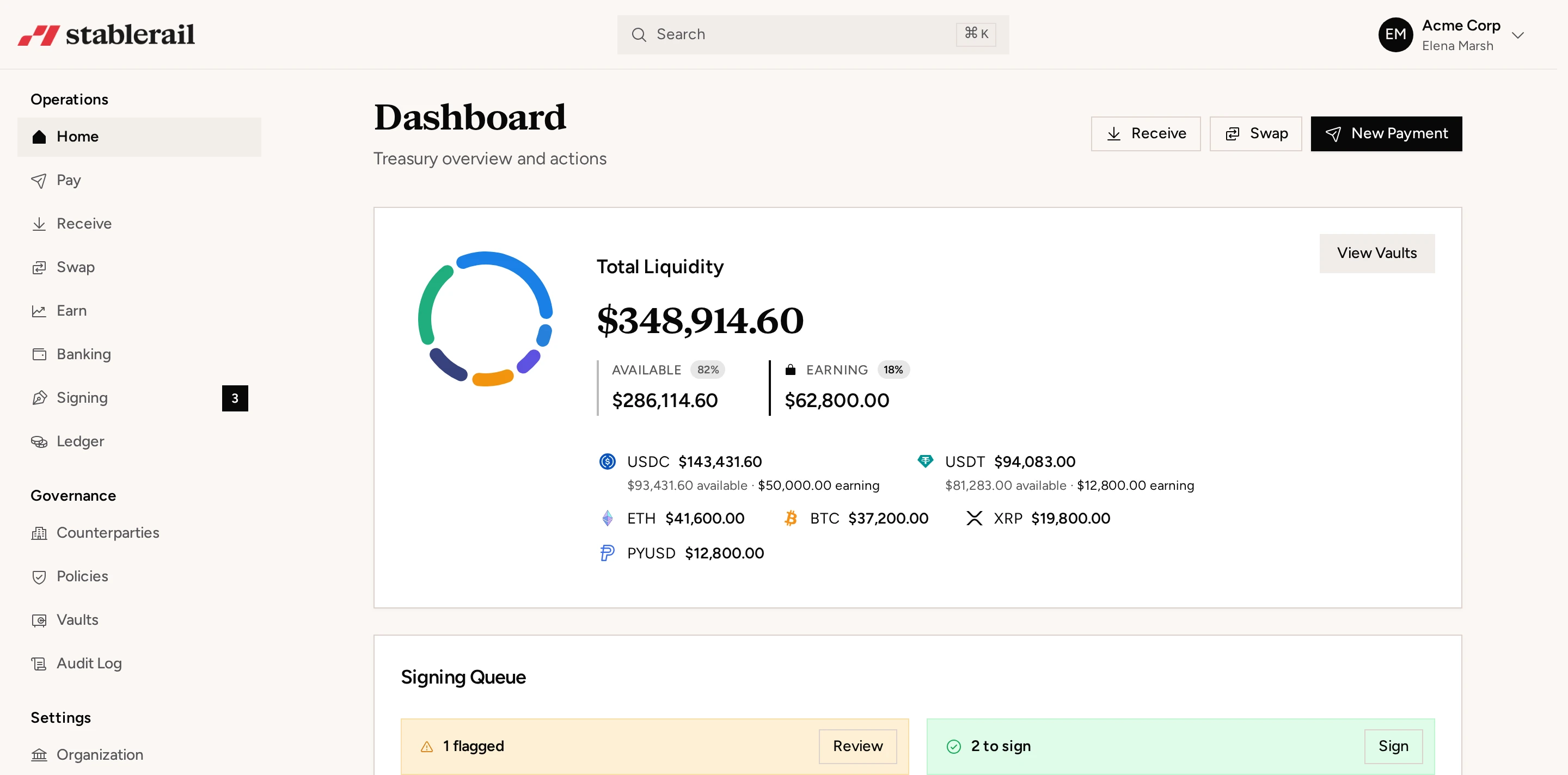
Stablerail streamlines the payment approval process by replacing fragmented manual methods with a structured system that enforces governance at every step. Positioned between custody management and transaction signing, this workflow ensures that every payment decision is verified, approved, and thoroughly documented before funds are transferred on-chain.
The 5-Step Workflow from Intent to Execution
The process begins when a payment intent is created. This can happen in several ways: uploading an invoice PDF, importing a payout CSV, or submitting details via an API. Once logged, Stablerail's agents generate a Risk Dossier that delivers a verdict - PASS, FLAG, or BLOCK - along with detailed explanations. Approvers then either accept the dossier's recommendation or override it, with overrides requiring a clear, recorded reason. After approval, the authorized signer executes the transaction using MPC-based signing in the "Approve & Sign" step. Finally, the system records the transaction and generates a receipt that captures the entire decision-making process.
"Every payment is simulated before execution. First-time destinations, address changes, and duplicates are caught before you sign." – Stablerail
This structured workflow ensures no payment bypasses verification, even under tight time constraints. By automating these steps, Stablerail eliminates the gaps often found in manual processes and ensures compliance is built into each stage.
Replacing Manual Processes with Automation
Stablerail's automated system addresses common errors and compliance challenges, as shown in this comparison:
Feature
Manual Process (Spreadsheets/Chat)
Stablerail Automated Workflow
Approvals
Informal messaging
Formal, multi-step policy-as-code engine
Risk Checks
Manual or post-transaction
Real-time, AI-driven pre-signature dossiers
Visibility
Spreadsheet reconciliation
Real-time unified treasury dashboard
Audit Trail
Hidden in chat logs or manual records
Automated, tamper-evident "Proof-of-Control"
Signing
"Blind signing" of technical hex data
Human-readable, contextual simulation
Efficiency
One-by-one manual execution
Batch processing (up to 500 transfers)
With batch processing, finance teams can handle up to 500 transfers using a single signature. This reduces repetitive tasks and significantly lowers the risk of manual errors.
Creating Audit Trails for Regulators and Boards
Stablerail's workflow doesn’t just improve efficiency - it also ensures full regulatory oversight. By embedding intent logging at every stage, the system creates an immutable audit trail that supports both risk management and compliance. This "Proof-of-Control" log provides auditor-grade evidence, documenting everything from the policy version applied to the risk engine's logic and the details reviewed by approvers before signing. For flagged transactions that move forward, the system captures explicit override reasons, ensuring transparency and accountability.
This level of documentation allows finance teams to defend their decisions long after transactions are completed, meeting the rigorous standards required for processes like traditional bank wire transfers.
Conclusion
After diving into payment risks and the workings of intent logging, it’s easy to see how this method reshapes treasury operations. Intent logging enhances how stablecoin payments are managed by catching address errors, policy violations, and insider missteps before funds are sent on-chain. By documenting every payment decision ahead of blockchain execution, this approach brings governance standards similar to traditional banking while maintaining blockchain’s speed and efficiency.
Stablerail’s system creates a critical decision layer between custody and signing, bridging the gap between asset storage and on-chain transactions. As they explain: “Agents verify the context. Humans sign the transaction. The system protects the treasury - it never touches the money.” This "copilot, not autopilot" model ensures that payments needing extra scrutiny - like large transfers to unfamiliar addresses or transactions outside normal patterns - are properly reviewed before being finalized.
For corporate treasuries, the advantages go beyond reducing risks. Teams can replace scattered spreadsheet-and-Slack workflows with a unified platform that simplifies approvals, centralizes risk management, and generates automated Proof-of-Control receipts. These receipts provide a detailed record of payments, including what was paid, why it was approved, who authorized it, and the system’s risk assessment - offering clear documentation for auditors, boards, and regulators. The shift in practice is striking: informal chat-based approvals evolve into structured, multi-step policy frameworks; post-transaction risk reviews give way to real-time, pre-signature analysis; and disorganized manual records are replaced by tamper-proof audit trails.
This isn’t just about avoiding errors - it’s about creating a treasury system that grows with the business while ensuring accountability and control. Intent logging signals a major improvement in how corporate treasuries handle stablecoins, delivering the kind of governance that was previously missing from this asset class.
FAQs
What exactly is intent logging in crypto payments?
Intent logging in crypto payments involves systematically recording payment instructions - or "intents" - before they are executed on the blockchain. On Stablerail's platform, this means capturing key details such as the transaction amount, recipient information, policy checks, and risk assessments.
By documenting every step with a comprehensive audit trail - including policy clauses, timestamps, and decision records - this process boosts transparency, ensures compliance, and strengthens accountability. This approach is crucial for managing and controlling irreversible transactions effectively.
How does intent logging stop a wrong wallet address before funds are sent?
Intent logging helps avoid mistakes, such as sending funds to incorrect wallet addresses, by capturing the payment intent and performing checks before any transaction is executed. These checks include policy verification, risk assessments, and human approvals, ensuring potential issues are identified and resolved before funds are signed and sent.
What evidence does intent logging produce for auditors and regulators?
Intent logging keeps a detailed record of every step in a workflow. This includes actions like creating intents, performing checks, flagging issues, making overrides, granting approvals, and finalizing with signatures. These logs serve as a transparent audit trail, offering clear evidence for auditors and regulators to confirm compliance and uphold accountability.
Related Blog Posts
Former CEO of Simple, a self-custodial wallet with $2B+ in transaction volume across 75+ countries.
More about the Stablerail team- Stablecoin treasury managementApprovals, limits, yield and reporting on one balance.
- Stablecoin payoutsBatch contractor and vendor payments with screening.
- USDT vs USDCWhich stablecoin your company should settle in.
- Stablecoin finance glossaryMPC, off-ramp, travel rule and the rest, in plain English.
- Product updatesEverything we ship, month by month.