
Ultimate Guide to Stablecoin Payment Anomaly Detection
Prevent suspicious stablecoin payments with behavioral analytics, wallet risk scoring, pre-sign controls and audit-ready logs.

Stablecoins offer fast, low-cost, 24/7 payment solutions, making them attractive for businesses. Yet, their instant, irreversible nature introduces risks like fraud, errors, and compliance violations. Detecting anomalies - irregular transaction patterns such as odd hours, unusual amounts, or suspicious wallet activity - is key to safeguarding corporate finances.
Key takeaways:
Anomalies: Include duplicate payments, transfers to risky wallets, or unusual patterns (e.g., payments at 3:00 AM).
Detection Methods: Use behavioral analytics, transaction pattern monitoring, and wallet risk scoring.
Pre-Sign Controls: Screen payments before execution to prevent fraud and ensure compliance.
Automated Tools: Reduce manual errors by enforcing policies like approval thresholds and sanctions checks.
For businesses managing stablecoin payments, combining automated anomaly detection with human oversight ensures security and compliance without slowing transactions.
Fraud is now AI versus AI
Methods for Detecting Stablecoin Payment Anomalies
Static Blocklisting vs Wallet Risk Scoring for Stablecoin Payment Security
Detecting anomalies in stablecoin payments calls for a layered strategy that combines historical data analysis, real-time monitoring, and risk scoring. Each method focuses on different aspects of payment behavior, such as irregular timing or suspicious wallet connections. Together, these techniques help guard against fraud, errors, and compliance risks. Let’s dive into three key methods: behavioral analytics, pattern monitoring, and wallet risk assessment.
Behavioral Anomaly Detection
Behavioral anomaly detection relies on historical transaction data to define what "normal" operations look like for your organization. Once a baseline is established, any significant deviations trigger alerts. For example, if your typical transactions occur between 9:00 AM and 5:00 PM EST on weekdays, a $15,000 payment at 2:30 AM on a Saturday would raise concerns. Similarly, a sudden $50,000 transfer to a vendor that usually receives $3,500 would be flagged as unusual.
Tools like Z-Score analysis help by measuring how far a transaction deviates from the average. A Z-Score above 3 often indicates an anomaly worth investigating. Machine learning models take it a step further, analyzing multiple factors - like transaction frequency, amounts, and time-of-day patterns - simultaneously. These models can spot subtle irregularities that basic rules might overlook while also learning over time to reduce false alarms. The next step involves monitoring transaction patterns for deeper insights.
Transaction Pattern Monitoring
Pattern monitoring examines the relationships and sequences between transactions, rather than viewing each payment in isolation. For instance, circular transfers - where funds loop back to the original wallet through intermediaries - can indicate potential money laundering. Similarly, "structuring", where large sums are split into smaller payments just under reporting thresholds (e.g., multiple $9,500 transfers instead of one $50,000 payment), is often used to evade compliance checks.
"Every payment is simulated before execution. First-time destinations, address changes, and duplicates are caught before you sign."
Real-time systems continuously monitor for these patterns, comparing current activity against known fraud schemes. When a high-risk pattern is detected, the system can escalate the transaction for review or block it outright, depending on your policies. Beyond tracking sequences, wallet-level risk scoring and clustering provide another layer of defense by identifying vulnerabilities tied to specific wallets.
Wallet Risk Scoring and Clustering
Not all wallet addresses pose the same level of risk. Wallet risk scoring assigns risk levels based on a wallet's transaction history, associations, and exposure to illicit activities. For example, a wallet with no ties to sanctioned entities and a clean history might score 5 out of 100, while one linked to darknet markets could score 95. Clustering analysis groups wallets by shared behaviors and connections, uncovering networks of related addresses that might belong to a single bad actor using multiple wallets to hide their identity.
This approach outperforms static blocklists, which only flag exact address matches. If a sanctioned entity creates a new wallet, a blocklist won’t catch it. However, risk scoring and clustering can identify the new wallet by analyzing its behavioral patterns and transaction links. This method enhances pre-sign controls by flagging risky wallet networks before any funds are transferred. The table below highlights the differences:
Feature
Static Blocklisting
Wallet Risk Scoring & Clustering
Detection Method
Matches exact addresses against a list.
Analyzes behavior, associations, and entity links.
Effectiveness
Low; easily bypassed by creating new wallets.
High; identifies rebranded or linked entities.
Context
Binary (Yes/No).
Nuanced (Risk scores, taint percentages).
Auditability
Basic record of the match.
Detailed "Risk Dossiers" with behavioral evidence.
Adding Anomaly Detection to Pre-Sign Payment Workflows
The best time to catch anomalies is before a payment leaves your wallet - not after it’s already on the blockchain. By combining existing detection methods with pre-sign checks, you turn anomaly detection into a proactive tool for fraud prevention. This approach revolves around three key elements: mandatory verification checks, automated enforcement of policies, and human oversight supported by detailed audit trails.
Mandatory Pre-Sign Checks
Before signing off on any payment, it must pass through a series of rigorous checks. These include:
Sanctions and taint screening: Flags wallets tied to illicit activities.
Policy enforcement: Ensures that each payment aligns with your approval thresholds and asset restrictions.
Behavioral checks: Compares the transaction against normal patterns.
Counterparty risk scoring: Evaluates the recipient wallet’s history and network connections.
The result of these checks is a Risk Dossier - a clear summary that provides a verdict of PASS, FLAG, or BLOCK. This dossier includes supporting evidence like timestamps and references to specific policies. For example, if a payment suddenly jumps from $5,000 to $500,000, it triggers a flag. By cross-referencing blockchain risk platforms, these checks enable fast and accurate screening. In fact, a Random Forest model trained on Ethereum data achieved a recall of 0.987 and an F1 score of 0.994 for anomaly detection, showcasing the precision modern machine learning can deliver.
Policy-as-Code for Automated Governance
Manual reviews and checklists leave too much room for error. That’s where policy-as-code comes in, transforming business rules into automated logic. These rules are applied to every payment intent, ensuring consistent enforcement. For instance, you can set policies like:
"Payments over $5,000 to new addresses require CFO approval."
"Weekend transfers exceeding $10,000 need additional authorization."
"Only allow USDC transfers on Base/Ethereum."
These policies monitor thresholds - such as $1,000, $5,000, and $10,000 - commonly used in anti-money laundering (AML) frameworks. If a transaction violates any rule, it’s blocked before reaching the signing stage. For example, if a $15,000 payment to a new wallet is initiated on a Sunday, the system halts it automatically and flags it for review. This layer also catches suspicious patterns, like rapid reciprocal transfers, which are often linked to money laundering. By doing so, only payments that meet all compliance requirements proceed to the next step.
Human-in-the-Loop Approvals and Audit Trails
Automated policies handle the first layer of control, but human oversight adds an extra layer of scrutiny for flagged transactions. When a FLAG verdict is issued - say, for a $30,000 midnight transfer from an account that typically handles low-volume payments - approvers step in. They review the Risk Dossier, analyze the evidence, and decide whether to approve the transaction with a documented reason or override the flag with proper justification. Final approval and signing happen through MPC ("Approve & Sign"), ensuring the security of self-custodial wallets.
Every action in this workflow is logged in a detailed audit trail. This record is invaluable for justifying decisions to auditors, boards, or regulators, especially when a transaction deviates from standard patterns. For high-volume operations handling 10,000 transactions a day, precision-focused models reduce false positives while ensuring no real threats slip through. The result? Stablecoin payments become as defensible and traceable as traditional bank wires, giving businesses a level of confidence that’s hard to match.
How Stablerail Detects Stablecoin Payment Anomalies
Stablerail serves as an agentic control plane positioned between custody and transaction signing. It provides finance teams with governance controls akin to those used for bank wires - while retaining the speed and efficiency of on-chain settlements. Built for businesses handling $1M–$50M in annual stablecoin transactions, Stablerail's subscription adapts based on the number of entities, active users, and transaction volume.
Its core principle is straightforward:
"Agents verify the context. Humans sign the transaction. The system protects the treasury - it never touches the money."
This design integrates pre-sign controls to fortify your treasury's security.
Self-Custodial MPC Wallets with Risk Controls
Stablerail utilizes MPC-based vaults to store funds across major EVM chains, supporting stablecoins like USDC and USDT. Importantly, the platform does not hold your keys or possess the ability to initiate transfers. Your funds remain secure in wallets where Stablerail has no unilateral signing authority. Instead, it enforces policy checks at the critical pre-sign stage.
This self-custodial model ensures your assets are stored in bankruptcy-immune vaults, safeguarding them even if third parties face financial trouble. Policies are automatically applied before signing, ensuring every transaction adheres to your risk and compliance rules. During this process, the copilot verifies the business context - examining details such as invoices, vendor history, and policy rationale - while leaving execution entirely in your hands. This setup ensures that risk controls are external to signing authority, reinforcing the security of the pre-sign framework.
Copilot Verification for Anomaly Detection
Stablerail's AI copilot runs a simulation before any transaction is signed, flagging potential anomalies. This process identifies issues such as first-time destinations, address changes, and duplicate transactions. It also detects behavioral irregularities like unusual transaction times, amounts that deviate from typical spending patterns, and suspicious payout behaviors.
For high-value transfers, the system automatically introduces a delay to allow for additional verification. If your "Golden Source" of vendor addresses flags an unexpected change, the payment is locked and escalated for review.
"The copilot can read policies, transaction context, and on-chain data. It cannot hold keys, initiate transfers, or sign. Its only role is to block, flag, and explain." (Stablerail)
Every transaction generates a detailed receipt, including the amount, rationale, approver, and risk assessment, ensuring your treasury is always audit-ready.
Treasury Hub and Policy Console Features
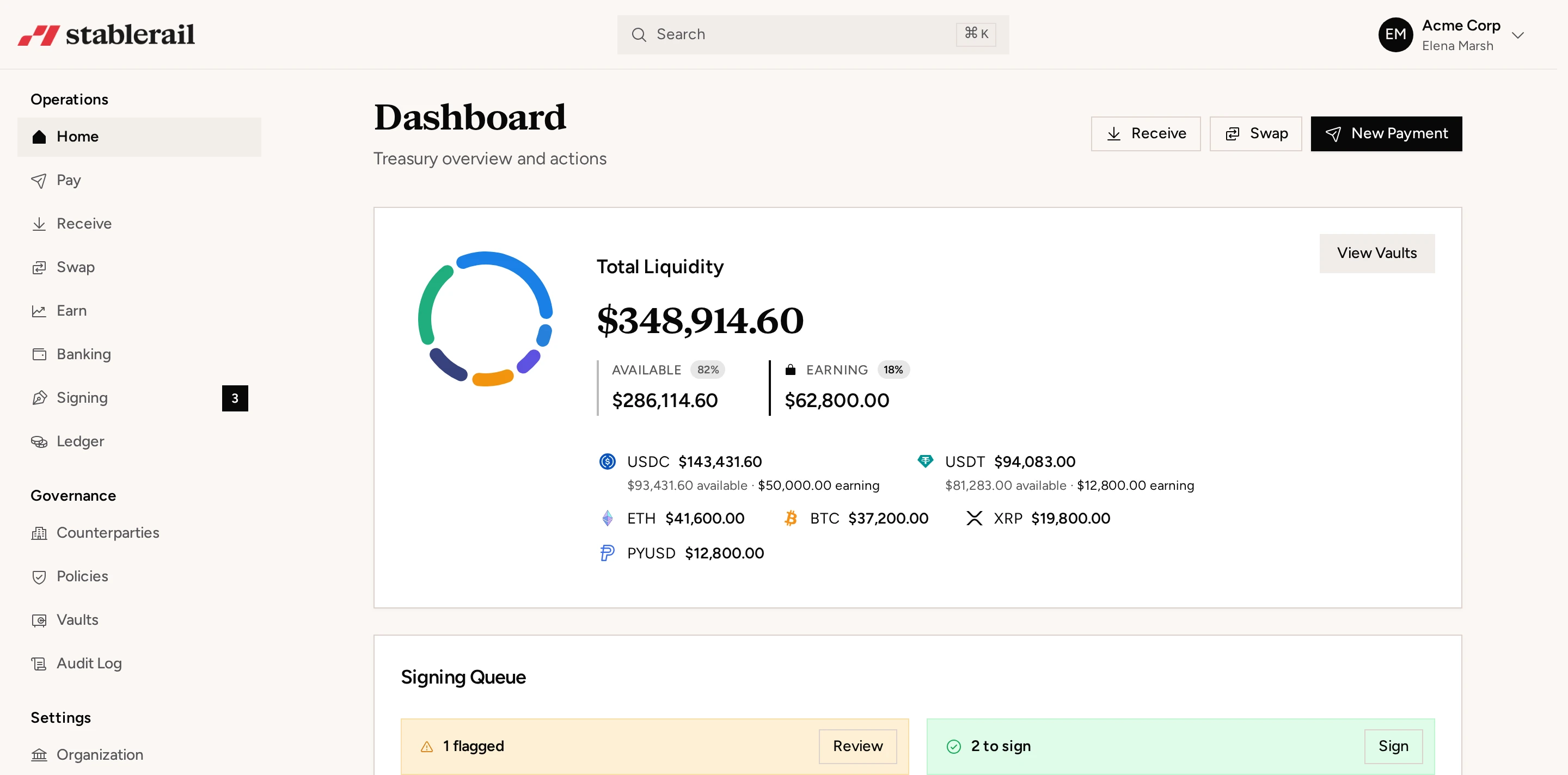
Stablerail enhances governance with its Treasury Hub and Policy Console. The Treasury Hub provides a centralized view of balances, entities, and supported chains, eliminating the chaos of managing stablecoins across multiple wallets and exchanges. Meanwhile, the Policy Console allows you to define and enforce payment governance rules, including roles, limits, and approval workflows, which are automatically applied to every transaction.
These tools replace the disjointed "wallet + spreadsheet + Slack approvals" approach with a streamlined, policy-driven workflow. Whether you're managing vendor payments, B2B transfers, or planning payroll and recurring transactions, Stablerail ensures every payment meets your compliance standards before it reaches the blockchain.
Best Practices for Detecting and Responding to Anomalies
These practices work alongside pre-sign controls to ensure anomalies are identified and addressed before payments leave your treasury.
Setting Baselines and Alerts for Anomalies
To effectively detect anomalies, start by establishing baselines. Monitor typical transaction amounts, frequency, timing, and counterparties to understand what "normal" looks like for your business. Once you have this foundation, set up real-time alerts for transactions that deviate from these patterns. For example, flag payments that are significantly higher or occur at unusual times, or transfers to new counterparties with unexpectedly large amounts.
The key is customizing statistical thresholds to align with your business's specific operations rather than relying on generic defaults. A manufacturing company making weekly supplier payments will have very different patterns compared to a software firm handling monthly subscription payments. Tailoring these thresholds ensures you catch irregularities without unnecessary disruptions.
Maintaining Continuous Oversight and Audit Readiness
Once baselines are in place, ongoing oversight is crucial. Create tiered approval workflows based on the level of risk. Routine payments to verified vendors might only need automated checks, while high-risk transactions - like those involving new counterparties or exceeding certain thresholds - should require additional reviews by finance officers.
For every flagged transaction, maintain a detailed audit trail. This should include information on who initiated the payment, the checks performed, triggered policies, and who approved or overrode the decision. Such documentation is essential if auditors, regulators, or board members later request evidence to justify a payment.
Regularly Updating and Tuning Detection Models
Anomaly detection models aren't static - they need regular updates to stay effective. Monitor metrics like override rates, false positives, detection speed, and reconciliation accuracy to refine your approach. For instance, if legitimate payments are frequently flagged, your thresholds may be too strict. On the other hand, if anomalies go unnoticed, your baselines might be outdated or too lenient.
Review and adjust detection policies periodically to reflect changes in transaction patterns, regulations, or emerging threats. As your business grows and payment behaviors evolve, recalibrating your thresholds ensures your anomaly detection remains reliable and adaptable over time.
Conclusion
Stablecoin payment anomalies pose a serious risk to corporate treasuries, but blockchain-based detection methods offer a way to mitigate these threats. Imagine catching a fraudulent $500,000 transfer before it goes through, rather than uncovering it during monthly reconciliations - this kind of proactive approach can save companies from irreversible financial losses.
The key lies in combining behavioral analytics, automated policy enforcement, and comprehensive audit trails. Machine learning models have already shown impressive accuracy on networks like Ethereum and Bitcoin, proving the effectiveness of automated anomaly detection.
What makes these systems indispensable is their ability to act before a transaction is signed. Sub-second pre-sign checks can flag anomalies, whether it’s a deviation from historical trends or a transaction involving a high-risk counterparty, all without slowing down the transaction process.
For finance teams managing stablecoin payments, these tools enhance human decision-making with real-time insights. Automated systems not only identify suspicious patterns instantly but also create immutable logs for every action, offering compliance teams a ready-made audit trail to demonstrate strong pre-sign controls.
FAQs
What anomalies matter most in stablecoin payments?
When it comes to stablecoin payments, certain anomalies can raise red flags. These include behavioral irregularities like unexpected transaction patterns, sudden spikes in volume, activity during unusual hours, or deviations from normal payout behavior. Such patterns often hint at potential issues that require closer scrutiny.
Other concerns involve gas fee anomalies, movements across multiple blockchain networks, and interactions with flagged wallets. These situations can signal risks related to fraud, compliance violations, or even operational weaknesses.
Identifying these anomalies as early as possible is critical. It helps mitigate risks tied to illicit activities, policy breaches, and security vulnerabilities, all while keeping operations compliant and secure.
How do I set baselines and thresholds without lots of false alarms?
To reduce false alarms, group transactions by their risk level and implement automated policies that match usual behavior patterns. Set thresholds that reflect your risk tolerance - for instance, automatically approving regular payments while flagging anything out of the ordinary. Using behavioral anomaly detection, such as analyzing transaction timing, amounts, or patterns, allows you to fine-tune these baselines over time. This approach keeps thresholds in sync with actual business activity while maintaining strong oversight.
What happens when a payment is flagged before signing?
When a payment is flagged before signing, the system creates a Risk Dossier that includes a verdict - either PASS, FLAG, or BLOCK - along with evidence to support the decision. Human approvers then review this dossier and decide whether to approve, override, or block the payment, ensuring it aligns with policy requirements. Every step of the process is documented in a detailed audit trail, providing clarity and accountability. This approach helps mitigate risks such as sanctions exposure or unusual activity before the payment is finalized.
Related Blog Posts
Former CEO of Simple, a self-custodial wallet with $2B+ in transaction volume across 75+ countries.
More about the Stablerail team- Stablecoin treasury managementApprovals, limits, yield and reporting on one balance.
- Stablecoin payoutsBatch contractor and vendor payments with screening.
- USDT vs USDCWhich stablecoin your company should settle in.
- Stablecoin finance glossaryMPC, off-ramp, travel rule and the rest, in plain English.
- Product updatesEverything we ship, month by month.