
How to Build a Risk Dossier for Stablecoin Transactions
A practical framework for documenting stablecoin payment intent, screening addresses, recording approval decisions and preserving audit evidence before and after execution.
A stablecoin transaction risk dossier is the evidence package supporting a payment decision. It should connect business purpose and beneficiary details to the exact wallet, network, token contract, screening results, policy verdict, approvals and final transaction hash. Build it before signing, update it after execution and retain the underlying evidence so auditors can reconstruct who approved the transfer, what they knew and why it proceeded.

What a stablecoin transaction risk dossier should contain
A risk dossier turns a proposed USDC or USDT transfer into a reviewable business transaction. It connects off-chain records, such as an invoice and vendor approval, with on-chain details, such as the destination address, network, token contract and transaction hash.
The dossier should answer five questions:
- Why is the payment being made?
- Who controls the destination address?
- What exactly will be signed?
- Which checks and approvals were completed?
- What happened after execution?
The record is more than a screening report. Address screening cannot establish the commercial purpose of a payment, prove who controls a wallet or show that the approved transaction matches the signed payload. A complete dossier combines those separate forms of evidence.
Build the dossier around the transaction lifecycle
Create the dossier when the payment is requested, not after funds have moved. Add evidence as the payment passes through validation, screening, approval, signing and reconciliation. This preserves the information available to each decision-maker at the time.
| Stage | Required evidence | Control objective | Owner |
|---|---|---|---|
| Request | Invoice, payment purpose, amount, asset, due date and requester | Establish a legitimate business obligation | Accounts payable or treasury |
| Beneficiary validation | Legal name, wallet address, ownership evidence and change history | Prevent payment to an incorrect or substituted address | Vendor management or treasury |
| Pre-sign review | Network, token contract, screening result, transaction preview and policy checks | Identify compliance, fraud and execution risks | Compliance and treasury |
| Approval and signing | Approvers, timestamps, decision, exception reason and signing quorum | Enforce segregation of duties and authority limits | Authorized approvers |
| Post-execution | Transaction hash, block status, network fee, ledger reference and reconciliation result | Prove execution and close the accounting record | Treasury and accounting |
Step 1: Capture payment intent
Start with the commercial reason for the transfer. Record the requester, legal counterparty, payment purpose, invoice or purchase order, due date, token amount and accounting entity. If the payment is denominated in fiat but settled in stablecoins, document the agreed conversion source and timestamp rather than relying on a later market price.
The request must also identify the proposed network and asset. “Send USDC” is insufficient because USDC exists on multiple networks, and unrelated tokens can use similar names or symbols. Record the chain identifier and token contract address from an approved source. For native token transfers or contract interactions, retain the transaction type and relevant contract details.
Use a unique internal payment ID to link the request, approval workflow, blockchain transaction and ledger entry. This prevents the on-chain hash from becoming an isolated record that accounting cannot connect to a business obligation.
Step 2: Validate the beneficiary and destination
Confirm that the legal beneficiary controls the destination address. Suitable evidence depends on the relationship and risk level. It may include a verified onboarding form, confirmation through an established contact channel, a signed message or a small test transaction. Do not accept a wallet change solely through the same email thread that requested it.
Maintain an approved beneficiary register containing the legal name, wallet address, supported network, asset, verification method, verifier and approval date. Treat a new address, changed address or first payment on a different network as a beneficiary change requiring renewed verification.
Address poisoning and clipboard replacement attacks exploit visual shortcuts. Reviewers should compare the full destination address against the approved record, preferably through a controlled system rather than matching only the first and last characters. A test transfer can reduce operational risk, but it does not replace independent ownership verification.
Step 3: Run checks before signing
Screen the destination address as close as practical to approval or signing. The retained evidence should identify the screening provider, query time, address, network, result, risk categories and provider reference or report. If the provider exposes the data source or list version, preserve that as well.
Sanctions and blockchain exposure checks serve different purposes. A sanctions result may identify a listed address or attributed entity. Exposure analysis estimates connections to categories such as theft, scams, ransomware or mixing services. Providers use different attribution data, tracing methods and thresholds, so a numerical score should not be treated as a universal fact.
Counterparty due diligence remains necessary. Politically exposed person checks, legal-name sanctions searches and jurisdictional review generally apply to people and entities, not merely to a blockchain address. Finance and compliance teams should determine which checks are required based on the counterparties, locations, transaction structure and applicable law.
For smart contract interactions, decode the transaction and simulate it where practical. The reviewer should be able to see the assets moving, recipient, allowances being granted and expected balance changes. For a straightforward token transfer, verify that the signed payload contains the approved contract, destination and amount.
Translate results into a decision
Use plain-language outcomes such as PASS, FLAG and BLOCK, but define them in treasury policy. These labels are internal decisions, not industry or regulatory standards.
| Verdict | Meaning | Required action | Evidence to retain |
|---|---|---|---|
| PASS | Required checks are complete and no policy exception was identified | Route to the normal approval queue | Check results, policy version and approver record |
| FLAG | A risk indicator or missing fact requires human review | Pause, investigate and record the decision | Finding, supporting documents, reviewer and rationale |
| BLOCK | A prohibited condition or unresolved critical issue is present | Do not sign or broadcast the transaction | Triggered rule, result, timestamp and escalation record |
A new wallet should not automatically be described as illicit, and an old wallet should not automatically be treated as safe. Wallet age, transaction history, unusual timing and first-time destinations are contextual indicators. Policy should specify when they trigger additional verification, a delay or a higher approval level.
Step 4: Record approvals, exceptions and signing evidence
The dossier should show who requested, reviewed, approved and signed the payment. Record each participant’s role, timestamp and decision. Approval authority should follow documented limits, while segregation of duties should prevent one person from creating a beneficiary, initiating the payment and unilaterally releasing funds.
Signing controls may use hardware wallets, multisignature wallets, multiparty signing arrangements or a custodian’s approval workflow. The key control is not the label attached to the technology. It is whether the configured signing quorum matches the company’s authority matrix and whether evidence shows that the required approvals occurred.
For an exception, require a specific rationale rather than a generic comment such as “approved by CFO.” Record the flagged condition, evidence reviewed, compensating control, approving authority and expiry of any temporary exception. An override should not erase the original alert.
A reviewer should be able to reconstruct the decision without asking the original operator what happened.
Step 5: Complete the dossier after execution
After broadcast, add the transaction hash, confirmed network, block time or status, sender, recipient, token contract, token amount and network fee. Compare these fields with the approved transaction. Any mismatch should become an exception for investigation rather than being silently reconciled.
Link the final transaction to the general ledger, invoice and internal payment ID. Record whether the payment failed, was replaced or was retried, because a second transaction can otherwise look like a duplicate. If a transfer is returned, create a separate linked record instead of changing the original history.
Retention should follow the company’s accounting, legal and compliance obligations. Preserve both a readable summary and the underlying evidence, including screening output, approvals and supporting documents. Access controls should prevent unauthorized edits, while the audit trail should show later annotations or corrections.
Finance-team implementation checklist
- Assign one internal ID to the request, approval, transaction and ledger entry.
- Record the exact network and verified token contract, not only the ticker symbol.
- Verify wallet ownership through an independent or previously trusted channel.
- Screen the destination before signing and retain the point-in-time result.
- Decode the transaction so approvers can compare intent with the signing payload.
- Require the correct approval and signing quorum for the amount and risk level.
- Document every flag, block and override with an owner and rationale.
- Reconcile the confirmed on-chain transaction to the approved request.
How to operationalize the dossier
A spreadsheet and document repository can work at low volume, but the process becomes fragile when wallet lists, screenshots, approvals and transaction hashes live in separate systems. At minimum, use required fields, controlled beneficiary records, role-based access and a consistent export format.
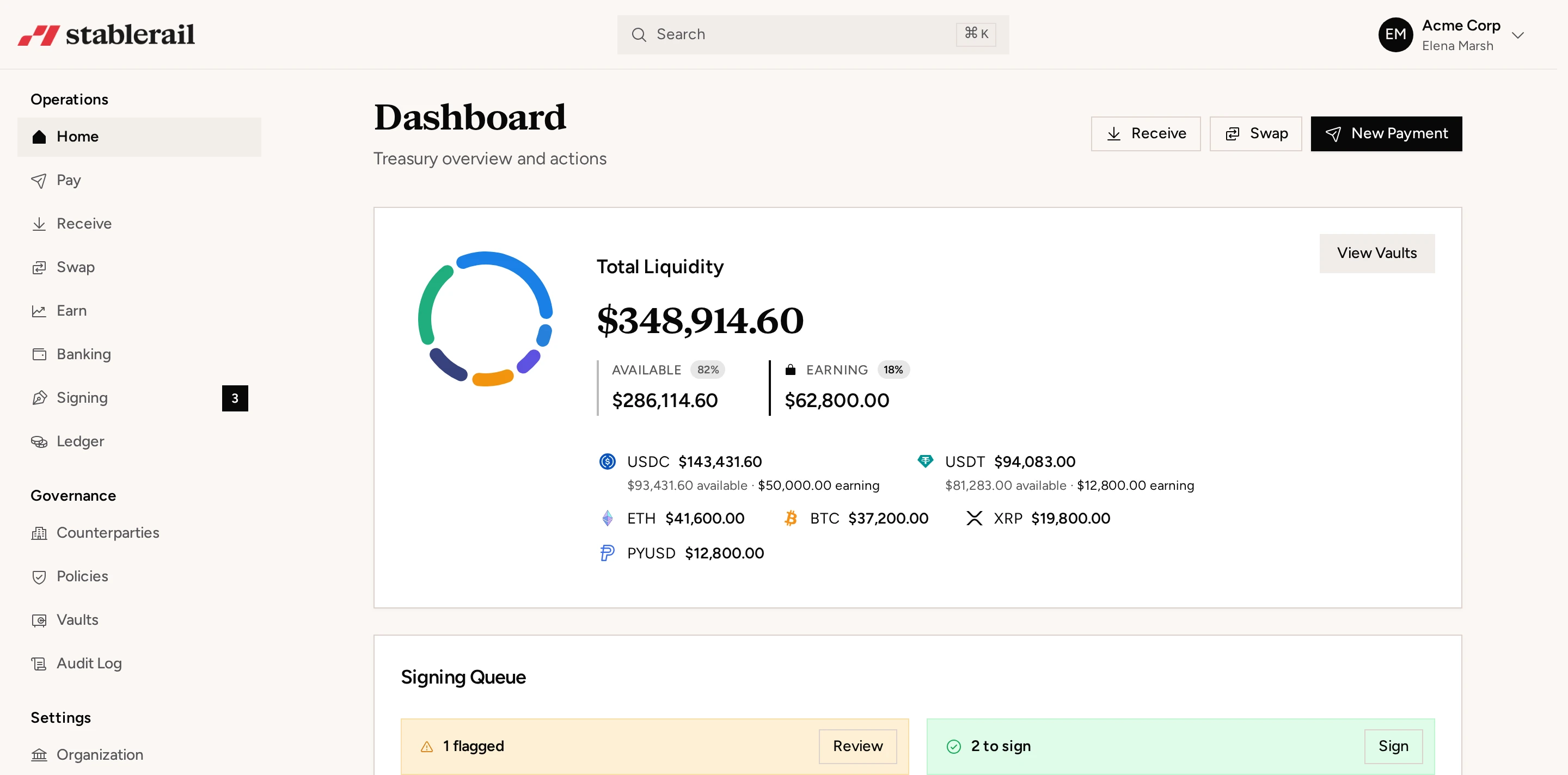
A treasury platform can bring the evidence together. Stablerail provides one business account for USDC and USDT treasury operations, with approvals and signing quorum, sanctions and address screening before send, global payouts, fiat off-ramp and exportable audit evidence. Whatever system is used, finance remains responsible for setting decision rules, assigning reviewers and confirming that the retained record meets the company’s obligations.
The strongest dossier does not promise that a transaction is risk-free. It demonstrates that the company understood the payment, checked the relevant risks, applied its policy, obtained authorized approval and preserved enough evidence to explain the decision later.
Frequently asked questions
What is a stablecoin transaction risk dossier?
It is the evidence package supporting a stablecoin payment decision. It combines business purpose, beneficiary and wallet details, screening results, policy findings, approvals, signing evidence and the final blockchain transaction record.
What evidence should be retained for a USDC or USDT payment?
Retain the invoice or payment request, legal counterparty, verified wallet address, network, token contract, screening output, approval timestamps and exception rationale. After execution, add the transaction hash, network fee, confirmation status and ledger reconciliation.
When should a stablecoin wallet be screened?
Screen the destination before the transaction is signed or broadcast, as close to execution as operationally practical. Retain a point-in-time report because address attribution and sanctions data can change after the payment.
Does a clean wallet screening result prove a transaction is safe?
No. Screening is one control and depends on the provider’s attribution data and methodology. It does not prove wallet ownership, validate the invoice or guarantee that the signing payload matches the approved payment.
How should finance teams handle a flagged stablecoin transaction?
Pause the payment and identify the specific issue, such as an unverified address, sanctions alert or unusual exposure. Record the investigation, evidence, reviewer and final rationale; if policy permits an override, preserve the original flag and approval rather than deleting it.
Former CEO of Simple, a self-custodial wallet with $2B+ in transaction volume across 75+ countries.
More about the Stablerail team- Stablecoin treasury managementApprovals, limits, yield and reporting on one balance.
- Stablecoin payoutsBatch contractor and vendor payments with screening.
- USDT vs USDCWhich stablecoin your company should settle in.
- Stablecoin finance glossaryMPC, off-ramp, travel rule and the rest, in plain English.
- Product updatesEverything we ship, month by month.