
Autonomous Finance vs Human Oversight
Autonomous systems deliver speed and consistency; people provide context and accountability. Learn how finance teams can combine both without creating approval bottlenecks or uncontrolled payments.
Autonomous finance is best for repeatable, low-risk work with clear rules, while human oversight is essential for exceptions, material transactions and decisions requiring context. Most finance teams should use a hybrid model: automate data collection, screening and routine execution, but require people to approve defined risk events. The right balance depends on transaction value, reversibility, confidence, regulatory exposure and the quality of audit evidence.

Autonomous finance and human oversight solve different problems. Software can monitor activity continuously, apply rules consistently and process routine work at scale. People can investigate ambiguity, challenge flawed assumptions and accept accountability for consequential decisions. A well-controlled finance operation does not maximize autonomy; it assigns each decision to the mechanism best equipped to handle its risk.
This distinction is especially important in stablecoin treasury. A payment instruction can move through screening and execution quickly, but speed does not establish that the destination address is correct, the underlying invoice is legitimate or the transfer was properly authorized. Because an onchain transfer generally cannot be recalled through a bank-style chargeback process, prevention and approval design matter more than after-the-fact recovery.
What is autonomous finance?
Autonomous finance refers to systems that can evaluate information, make bounded decisions and take financial actions without a person approving every step. Examples include matching incoming payments to invoices, generating cash forecasts, routing payments, screening wallet addresses, rebalancing liquidity and releasing transactions that satisfy predefined conditions.
Autonomy is not the same as basic automation. Automation follows a specified workflow, such as creating a journal entry when a payment settles. An autonomous system has discretion within a defined boundary, such as choosing when or where to move liquidity based on balances, costs and risk signals.
The underlying decision mechanism also matters. Deterministic rules produce the same result from the same inputs and are usually easier to test. Statistical models produce scores or predictions, while generative or agentic systems may plan and initiate a sequence of actions. Giving a system broader discretion increases the need for limits, monitoring and a reliable way to stop it.
Where autonomy performs well
- Structured, repetitive work: Matching records, checking required fields and applying stable rules.
- Continuous monitoring: Watching balances, transaction status and risk signals outside business hours.
- High-volume decisions: Processing cases that would overwhelm a manual queue when the inputs and outcomes are well defined.
- Consistent controls: Applying the same threshold, allowlist or screening step to every relevant transaction.
These strengths depend on input quality. A system can apply a rule perfectly and still reach the wrong outcome if the vendor master data is stale, an API returns incomplete information or a compromised user submits an apparently valid instruction.
What human oversight contributes
Human oversight means that named people supervise, approve, investigate or override parts of a financial process. It should not mean asking an employee to review every automated result. Effective oversight places people at decision points where business context can materially change the outcome.
For example, an address-screening result can identify exposure that requires review, but it may not explain the commercial purpose of the payment or whether the counterparty relationship is legitimate. A treasury reviewer can compare the request with the contract, invoice, vendor history and expected payment pattern before deciding whether to proceed.
Humans are also needed to own the control framework. Someone must define acceptable risk, approve thresholds, decide which systems may initiate payments and respond when actual outcomes differ from expectations. Accountability cannot be delegated merely by labeling a process autonomous.
Where human review fails
Manual control is not automatically strong control. Reviewers can become fatigued, approve requests without examining the evidence or rely on information supplied by the person who initiated the payment. Oversight is particularly weak when approval requests lack context or when escalation paths are unclear.
A human approval is useful only if the reviewer is independent, authorized, informed and given enough time to intervene. The system should show what changed, why the transaction was flagged, who initiated it and which supporting records apply. It should also preserve the decision and its rationale for later review.
Autonomous finance vs human oversight
| Decision factor | Autonomous finance | Human oversight | Practical hybrid control |
|---|---|---|---|
| Speed and availability | Can operate continuously once inputs and permissions are available | Depends on reviewer availability and queue size | Process routine cases automatically; page an on-call approver only for defined exceptions |
| Consistency | Applies encoded rules consistently | Judgment can vary between reviewers | Use standard decision criteria and require a reason for overrides |
| Context | Limited to available data, integrations and model capability | Can evaluate commercial purpose and unusual circumstances | Attach contracts, invoices, counterparty history and risk results to the approval |
| Scalability | Handles more volume without a matching increase in manual reviews | Capacity grows with trained staffing | Send only material, unusual or low-confidence cases to people |
| Error impact | A flawed rule or credential can repeat an error rapidly | A reviewer can interrupt a bad pattern but can also make mistakes | Set transaction and period limits, separate duties and provide a kill switch |
| Auditability | Can record inputs, outputs and system actions | Can document rationale and accountability | Retain both machine evidence and the human decision trail |
| Best fit | Low-risk, repeatable and reversible processes | Ambiguous, material or hard-to-reverse decisions | Increase review as value, uncertainty or irreversibility rises |
The main risks of excessive autonomy
Errors can propagate before anyone responds
An incorrect limit, compromised credential or faulty integration can affect many transactions rather than one. Controls should therefore limit both individual transfers and cumulative exposure over a period. Monitoring should detect unusual velocity, new destinations and deviations from expected behavior.
Models can be confidently wrong
A forecast, anomaly score or generated recommendation is not a fact. Performance can deteriorate when business conditions, customer behavior or source data change. Finance teams should measure outcomes against approved benchmarks, record model or rule versions and route low-confidence results to review rather than forcing a decision.
Execution records do not explain intent
A blockchain record can establish that a transaction occurred from one address to another. It does not by itself prove who approved the payment, which legal entity owned the wallet, what obligation was being settled or why an exception was accepted. Audit evidence must connect the onchain transaction to the business request, screening results, approvals and accounting records.
Permissions can be broader than intended
An agent with access to a wallet, exchange account or banking interface may be able to perform more actions than its stated task requires. Use least-privilege access, restrict permitted assets and destinations where possible, separate instruction creation from authorization, and rotate or revoke credentials when responsibilities change.
How to design a hybrid operating model
Start with the decision, not the technology. Document what the system is allowed to do, which conditions require a person and who can stop execution. Risk tiers should consider more than payment size: include destination novelty, counterparty risk, asset, network, legal entity, business purpose, confidence level and whether the action can be reversed.
A stablecoin payment workflow might automate balance checks, duplicate detection, sanctions and address screening, fee estimation, transaction construction and status reconciliation. Human approval can then be required for a new wallet, a screening alert, a material amount, changed vendor instructions or an out-of-policy request. Signing quorum can prevent one user or compromised credential from unilaterally releasing funds.
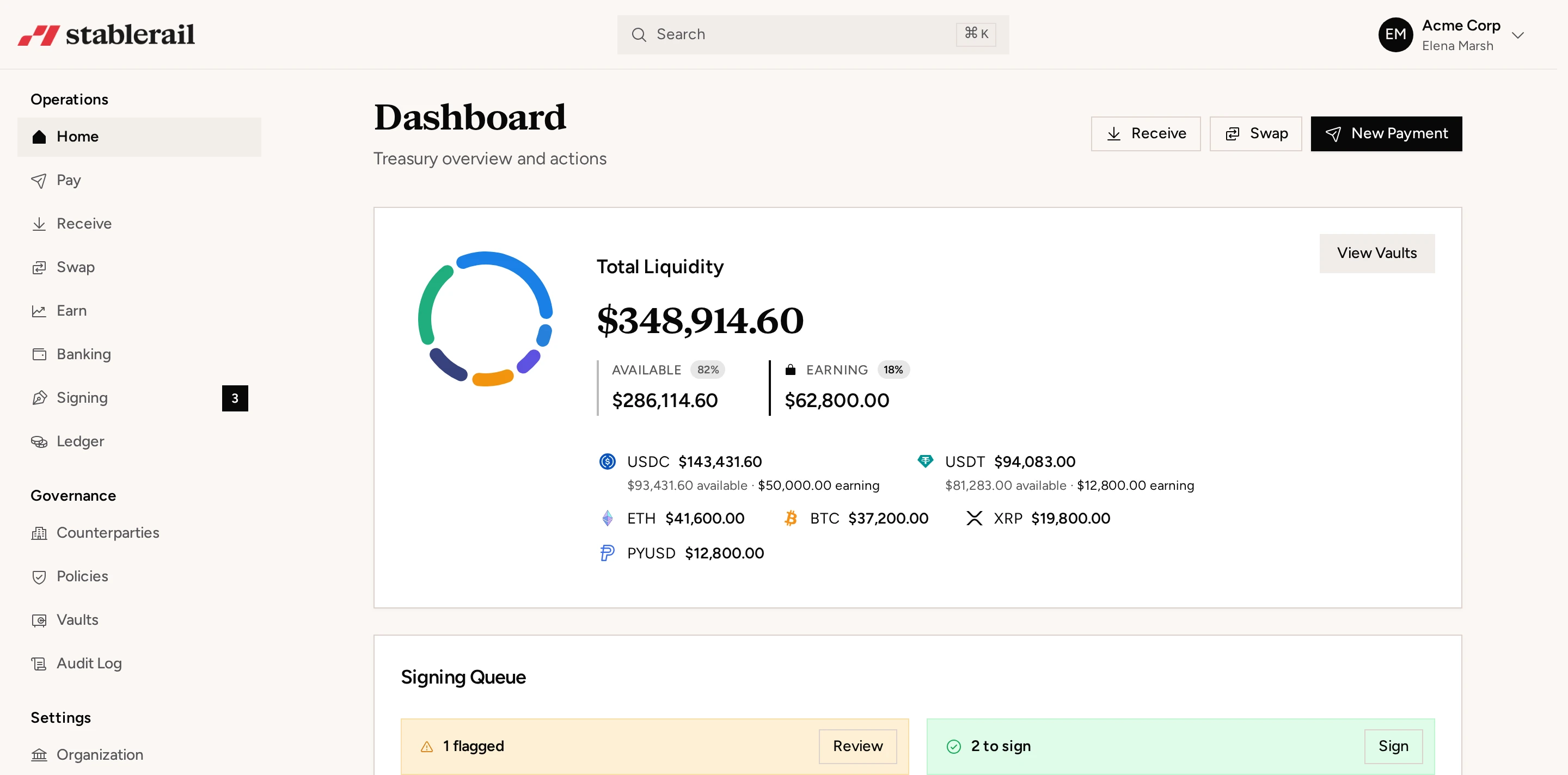
Stablerail supports this hybrid approach through approvals and signing quorum, sanctions and address screening before send, and exportable audit evidence, alongside corporate cards, global payouts and fiat off-ramp capabilities for USDC and USDT treasury operations.
A finance-team implementation checklist
- Inventory decisions: List every process that can create, approve, sign, route, convert or reconcile a financial transaction.
- Classify impact: Score decisions by value, frequency, reversibility, counterparty risk and regulatory relevance.
- Set authority boundaries: Define permitted assets, networks, entities, destinations, transaction limits and cumulative limits.
- Separate duties: Avoid giving the same person or system unrestricted ability to create and release a payment.
- Design escalation: Specify which alerts stop execution, who reviews them and what evidence is required to proceed.
- Test failure modes: Simulate bad data, unavailable screening, duplicate instructions, compromised access and delayed approvals.
- Retain evidence: Export requests, approvals, screening outputs, signatures, transaction identifiers and reconciliation records.
How much human oversight is enough?
The answer is not a fixed approval count. Oversight is sufficient when people can understand the system's authority, intervene before unacceptable harm, review meaningful exceptions and reconstruct a decision afterward. Adding more approval clicks without better information or independence usually increases delay rather than control.
Track whether the model is working through operational measures such as exception volume, review time, override rate, failed or duplicated transactions, unauthorized attempts, reconciliation breaks and the age of unresolved alerts. A rising override rate may indicate that rules no longer match business reality; an extremely low rate may mean either excellent calibration or superficial review.
The strongest design is proportional. Automate steps where the logic is stable and errors are contained. Require informed human judgment where uncertainty, materiality or irreversibility is high. This preserves the speed of autonomous finance without surrendering the accountability expected from a finance function.
Frequently asked questions
What is the difference between autonomous finance and finance automation?
Finance automation executes predefined steps, such as matching a payment to an invoice. Autonomous finance can make bounded decisions and take actions based on data, rules or models, so it requires tighter authority limits and monitoring.
Does autonomous finance eliminate the need for human approval?
No. Routine, low-risk cases may proceed without transaction-by-transaction approval, but material, unusual or hard-to-reverse actions should trigger human review. People must also own limits, exceptions, access rights and incident response.
Which stablecoin payments should require human approval?
Human approval is appropriate for new or changed destination wallets, screening alerts, material transfers, unusual transaction patterns and policy exceptions. The threshold should reflect cumulative exposure and irreversibility as well as the amount of a single payment.
How can a company audit autonomous financial transactions?
Retain the instruction, input data, applicable rule or model version, screening result, approval or override, signer evidence and final transaction identifier. Onchain records prove execution, but they do not establish the business purpose or authorization by themselves.
What controls should an autonomous treasury system have?
Core controls include least-privilege access, transaction and cumulative limits, separation of duties, signing quorum, destination controls, pre-send screening, exception escalation and a way to stop execution. Teams should also reconcile outcomes and periodically test failure scenarios.
Former CEO of Simple, a self-custodial wallet with $2B+ in transaction volume across 75+ countries.
More about the Stablerail team- Stablecoin treasury managementApprovals, limits, yield and reporting on one balance.
- Stablecoin payoutsBatch contractor and vendor payments with screening.
- USDT vs USDCWhich stablecoin your company should settle in.
- Stablecoin finance glossaryMPC, off-ramp, travel rule and the rest, in plain English.
- Product updatesEverything we ship, month by month.