
AI in Sanctions Screening: Reducing False Positives
Learn how AI improves sanctions screening through entity resolution, contextual matching and risk ranking, plus the controls finance teams need before using it.
AI reduces sanctions-screening false positives by comparing more than names. It uses transliteration, entity resolution and contextual identifiers—such as date of birth, country, ownership and wallet data—to distinguish real matches from superficial similarities. The safest systems use AI to rank or enrich alerts while preserving sanctions-list coverage, human escalation, documented decisions, model testing and a complete audit trail.

Why sanctions screening produces false positives
A sanctions-screening false positive occurs when a legitimate customer, counterparty or payment is flagged even though it does not involve a sanctioned party. The most common cause is a superficial name similarity: a customer shares a name, spelling variant or transliteration with an entry on a sanctions list.
Conventional screening engines generally compare customer or payment data with names and aliases published by authorities such as the US Office of Foreign Assets Control, the United Nations and the European Union. To avoid missing genuine matches, teams often configure broad thresholds. That improves sensitivity but can generate large volumes of irrelevant alerts.
Several data problems make those alerts harder to resolve:
- Common names and initials: A short or widely used name may match many unrelated people.
- Transliteration: A name written in Arabic, Cyrillic or another script can have several valid Latin-script spellings.
- Unstructured fields: Combining a full name, address and company suffix in one field makes reliable comparison difficult.
- Missing identifiers: A name alert cannot be dismissed confidently when date of birth, nationality, registration number or address is unavailable.
- Entity-type confusion: Screening a company as a person, or treating generic words such as “trading” as distinctive, creates weak matches.
False positives are not merely an efficiency problem. Excessive alert volume can create reviewer fatigue, delay payments and produce inconsistent case notes. The objective is therefore not to suppress alerts indiscriminately. It is to separate weak similarities from plausible sanctions exposure without reducing the system’s ability to detect true matches.
How AI reduces false positives
AI improves sanctions screening by resolving identity and context rather than relying only on character similarity. It can supplement deterministic rules and fuzzy matching, but it should not replace the underlying obligation to screen relevant parties and investigate credible alerts.
1. Better name normalization and transliteration
Natural language processing can normalize capitalization, punctuation, word order, legal suffixes and spacing before comparison. Language-aware models can also recognize that two differently transliterated names may represent the same original name.
Token classification adds further precision. A model can distinguish a person’s surname from a company suffix or identify generic business terms that should carry less weight. This reduces alerts caused by words that are common but not useful for identity matching.
2. Entity resolution using secondary identifiers
Entity resolution asks whether two records describe the same real-world person or organization. A model may compare name similarity alongside date of birth, nationality, address, place of incorporation, company number, passport number and known aliases.
A strong mismatch can be as informative as a match. For example, an exact name match accompanied by incompatible dates of birth and countries may warrant a lower priority. That does not necessarily justify automatic closure: missing data, aliases and list quality must be considered.
3. Contextual risk scoring
Machine-learning models can assign an alert score based on multiple signals rather than applying one threshold to every record. A score might incorporate name quality, identifier overlap, list source, jurisdiction, ownership links and prior adjudications involving the same verified entity.
This enables risk-based queues. High-confidence matches can be escalated immediately, ambiguous cases can receive analyst review, and clearly explainable mismatches can follow an approved lower-risk workflow. Thresholds should be governed by documented risk appetite and tested against known matches—not selected solely to reduce workload.
4. Alert enrichment and summarization
Generative AI can help analysts assemble relevant fields, highlight agreements and conflicts, and draft a case summary. Used carefully, this shortens the mechanical part of an investigation. It should not invent missing facts, treat external web content as authoritative or make an unreviewed final legal determination.
A useful explanation is specific: “Names match after transliteration; month and year of birth match; nationality conflicts; no unique identifier is available.” A bare score or an unsupported statement that a model considers the alert safe is not adequate evidence.
Legacy and AI-assisted screening compared
| Criterion | Legacy name matching | AI-assisted screening | Control finance teams need |
|---|---|---|---|
| Name comparison | Exact or fuzzy character similarity | Normalization, token weighting and language-aware transliteration | Test cases covering aliases, scripts and word-order changes |
| Identity context | Often reviewed manually after an alert | Dates, addresses and entity attributes can affect prioritization | Data lineage and rules for missing or conflicting fields |
| Alert handling | Broad queues ordered by time or a basic score | Alerts ranked by estimated match risk | Defined escalation bands and human-review requirements |
| Explanations | Matched text and similarity score | Field-level reasons, supporting signals and mismatches | Reproducible decision record retained with the case |
| Change management | Threshold and rule updates | Rules, model versions, prompts and data inputs may change | Version control, validation and approval before deployment |
| Primary failure risk | Too many irrelevant alerts | Opaque scoring or unjustified automatic dismissal | Recall testing, override monitoring and periodic review |
Stablecoin payments require more than name screening
For stablecoin treasury operations, screening the beneficiary’s name is only one layer. A finance team may also need to screen the destination blockchain address, relevant counterparties and the entities controlling them. Designated wallet addresses can appear on sanctions lists, while blockchain analytics may identify exposure or attribution that is not visible from the legal name alone.
These controls answer different questions. Name screening evaluates whether a party resembles a listed person or entity. Address screening checks whether a wallet is designated or associated with identified risk. Ownership analysis determines whether an entity may be treated as blocked because sanctioned persons own it, including through aggregated ownership where the applicable sanctions rules require that analysis.
Screening should occur before authorization or execution, when the team can still stop the transfer. If a payment remains queued or lists and risk data change, the workflow should define when re-screening is required. A compliant result at onboarding does not guarantee that a destination remains acceptable later.
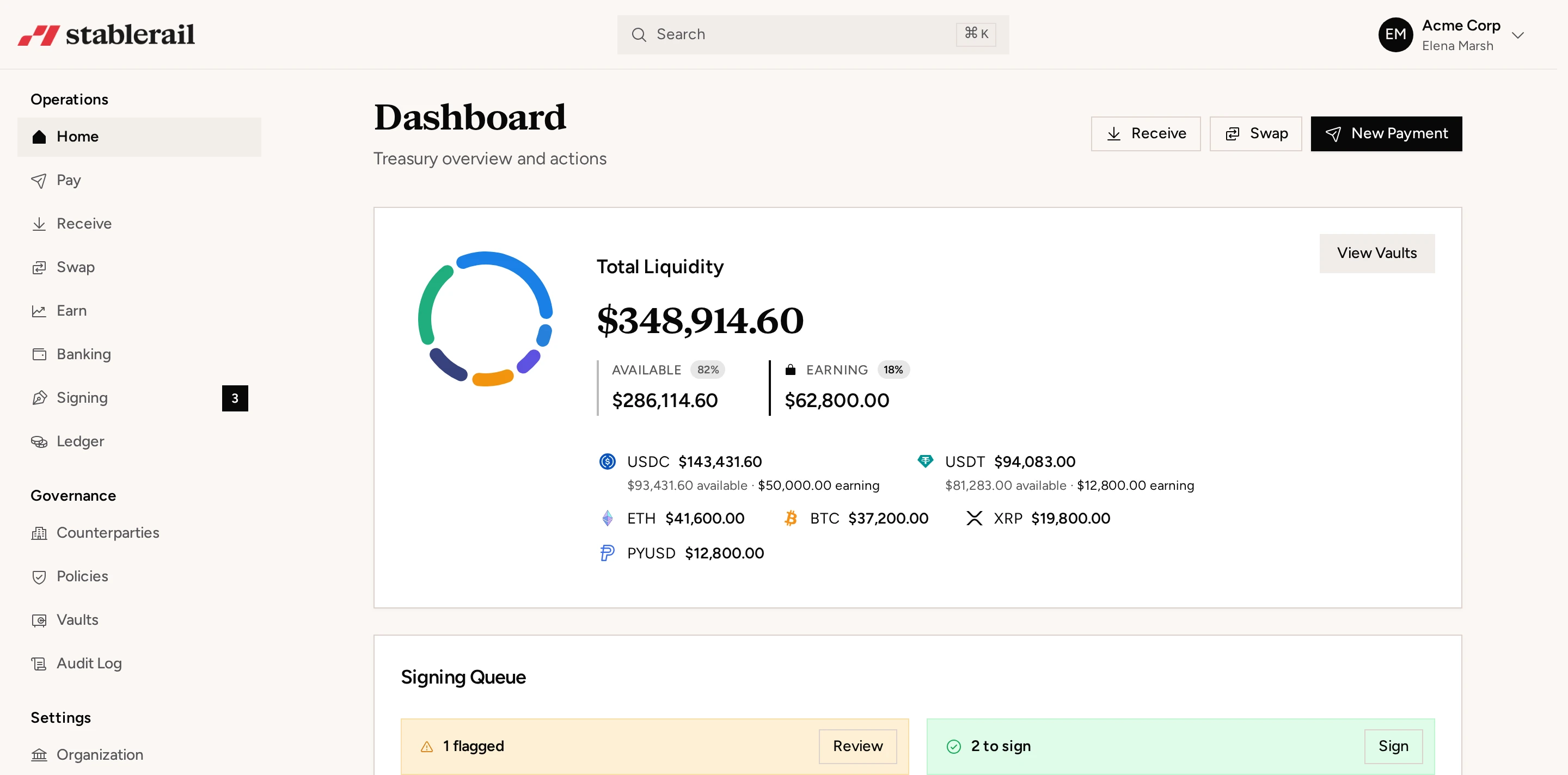
Stablerail supports USDC and USDT treasury workflows with approvals and signing quorum, sanctions and address screening before send, and exportable audit evidence. The operational benefit is connecting screening to payment authorization rather than leaving evidence across disconnected wallets, spreadsheets and messaging tools.
Controls needed before automating alert decisions
AI does not remove accountability from the institution using it. The OFAC Framework for Compliance Commitments emphasizes management commitment, risk assessment, internal controls, testing and auditing, and training. An AI-assisted process should fit within those controls rather than operate as an unexplained exception.
Finance, compliance and engineering teams should complete this checklist before allowing a model to prioritize or close alerts:
- Define the permitted use. State whether AI may enrich, rank, recommend closure or automatically close an alert.
- Protect coverage. Test known true matches, aliases, transliterations and incomplete records before optimizing false-positive rates.
- Document inputs. Record list versions, customer data, wallet intelligence, model version and matching configuration.
- Set escalation rules. Require human review for high-risk scores, conflicting identifiers, ownership concerns and insufficient data.
- Retain evidence. Preserve the original alert, model explanation, analyst decision, approvals and payment outcome.
- Monitor overrides. Review cases where analysts disagree with the model; repeated disagreement may indicate drift or a bad threshold.
- Plan for failure. Maintain a fallback process if the model, vendor or enrichment source is unavailable.
How to measure whether AI is actually improving screening
A lower alert count is not proof of a better system. Teams should measure efficiency and detection quality together. Useful measures include the percentage of screened records that generate alerts, analyst handling time, escalation rate, closure reasons, model-versus-analyst disagreement and the number of known test matches detected.
Precision measures how many escalated alerts are relevant. Recall measures how many relevant matches the system detects. Raising a threshold may improve precision while reducing recall, so both must be assessed. Because confirmed sanctions matches are uncommon, validation should include controlled test records and difficult edge cases rather than relying only on historical production outcomes.
Results should also be segmented. A model can perform well overall while failing on a particular script, jurisdiction, entity type or data source. Review performance after material list changes, data-pipeline changes and model updates. The defensible outcome is not “AI generated fewer alerts,” but “testing showed that the revised workflow removed explainable noise while preserving required detection coverage and review evidence.”
The practical standard: faster decisions that remain defensible
The strongest AI sanctions-screening systems are not black boxes that declare counterparties safe. They are structured decision-support tools: they normalize names, resolve entities, bring relevant context into the case and direct analyst attention to the most credible risks.
For CFOs and treasury leads, the purchasing decision should turn on more than the promised reduction in alerts. Evaluate data coverage, field-level explanations, testing capability, threshold governance, human overrides, evidence retention and integration with payment approvals. Reducing false positives creates value only when the resulting decisions remain accurate, reviewable and capable of stopping a prohibited payment before funds move.
Frequently asked questions
Can AI automatically clear sanctions-screening alerts?
It can support automatic closure only where the institution has defined and validated a narrow, explainable workflow. High-risk matches, conflicting identifiers, missing data and ownership concerns should generally be escalated for human review, with the model inputs and decision retained.
How does AI reduce false positives in name screening?
AI normalizes names, handles transliteration and weighs distinctive name components instead of treating every character equally. It can then compare secondary identifiers such as date of birth, nationality, address and company number to determine whether two records likely refer to the same entity.
What is the difference between name screening and wallet screening?
Name screening compares people and organizations with sanctions-list entries. Wallet screening checks blockchain addresses for designation, attribution or relevant exposure; stablecoin payments may require both because a benign-looking legal name does not establish that the destination address is acceptable.
Which metrics should a CFO track for AI sanctions screening?
Track alert rate, analyst handling time, escalation rate, override rate and closure reasons. Pair those efficiency measures with precision, recall, known-match test performance and results segmented by language, entity type and data source.
What audit evidence should an AI screening system retain?
Retain the sanctions-list version, screened party and wallet data, model or rule version, matching signals, explanation, analyst notes, approvals and final payment disposition. The record should allow an independent reviewer to reconstruct why the transaction proceeded, stopped or was escalated.
Former CEO of Simple, a self-custodial wallet with $2B+ in transaction volume across 75+ countries.
More about the Stablerail team- Stablecoin treasury managementApprovals, limits, yield and reporting on one balance.
- Stablecoin payoutsBatch contractor and vendor payments with screening.
- USDT vs USDCWhich stablecoin your company should settle in.
- Stablecoin finance glossaryMPC, off-ramp, travel rule and the rest, in plain English.
- Product updatesEverything we ship, month by month.