
Ultimate Guide to Withholding Tax for Stablecoin Payments
U.S. rules for stablecoin payments: treat them as property, calculate USD fair market value at payment, apply withholding/reporting, and keep detailed records.

Mar 31, 2026
When paying with stablecoins like USDC or USDT, U.S. tax laws treat them as property, not currency. This means every transaction is a taxable event, requiring you to calculate the fair market value (FMV) in USD at the time of payment. Here’s what you need to know:
For employees: Taxes like federal income, Social Security, and Medicare apply, and payments must be reported on Form W-2.
For contractors: Payments over $600 require Form 1099-NEC.
Cross-border payments: Subject to a 30% withholding tax unless reduced by a tax treaty (requires Form W-8BEN).
New reporting rules starting 2026: Brokers must issue Form 1099-DA for stablecoin transactions, including cost basis details.
Recordkeeping: Maintain detailed transaction logs, including FMV at payment time, to ensure compliance.
Failure to comply can lead to penalties, audits, and interest. Tools like Stablerail can help automate compliance by verifying tax forms, calculating withholdings, and maintaining audit trails.
Key takeaway: Treat stablecoin payments as property transactions, calculate taxes based on USD value at payment time, and follow reporting and withholding requirements to avoid penalties.
Regulatory Framework for Withholding Tax on Stablecoin Payments
IRS Treatment of Stablecoins as Property
The IRS categorizes stablecoins, such as USDC and USDT, as digital assets. Every transaction involving these stablecoins - whether it's paying a vendor, swapping tokens, or converting them into cash - is treated as a property disposition. This means capital gains or losses must be calculated based on the cost basis of the asset. Even though stablecoins are pegged to $1.00, slight fluctuations above or below this value can occur. Therefore, it's essential to document the fair market value in USD for each transaction.
US Withholding Tax Rules Overview
The IRS's classification of stablecoins as property directly influences how U.S. tax rules apply to domestic and international transactions involving these assets.
For cross-border payments to foreign entities, the default withholding tax rate is 30% on FDAP (Fixed, Determinable, Annual, or Periodical) income derived from stablecoin payments. However, tax treaties can reduce this rate, provided the recipient submits the proper documentation, usually Form W-8BEN. Businesses must also report these transactions using Form 1042-S.
Domestic payments follow typical IRS withholding guidelines. For U.S.-based contractors, businesses must issue a Form 1099-NEC if total stablecoin payments exceed $600 in a calendar year. For employees, standard withholdings for federal income tax, Social Security, and Medicare apply. Crucially, all withholdings are calculated based on the USD value at the time of payment, not when the stablecoins were initially acquired.
These rules emphasize the importance of maintaining detailed records to ensure compliance with withholding and reporting obligations.
Reporting Requirements for Businesses
Starting with transactions in 2025 (reported during the 2026 tax season), brokers will be required to issue Form 1099-DA for gross proceeds from stablecoin dispositions. From January 1, 2026, this requirement expands to include cost basis reporting, meaning brokers must track acquisition dates, costs, and fees for each transaction.
Additionally, under the Infrastructure Investment and Jobs Act, businesses must report any stablecoin transactions exceeding $10,000 on Form 8300. This applies to single transactions or a series of related transactions occurring within a 24-hour period. For payroll, wages paid in stablecoins should be reported on Form W-2, with withholdings submitted via Form 941.
These detailed reporting requirements aim to streamline compliance processes, as highlighted by Milos Djukanovic:
"The major shift is operational: expanded broker reporting, tighter cost basis expectations, and a compliance stack designed to reduce underreporting." - Milos Djukanovic
Crypto Taxes Just Got Serious | IRS Enforcement Shift Explained
Withholding Tax Rules Across Different Countries
Withholding Tax Rates and Reporting Requirements for Stablecoin Payments by Jurisdiction
Withholding Tax Rates by Country
When it comes to withholding tax on stablecoin payments, rules differ widely depending on the country. For instance, in the United States, there's a default 30% withholding rate for payments to foreign individuals unless a tax treaty lowers that percentage. In Canada, the withholding rate typically falls between 15% and 25% for cross-border payments to non-residents. Over in the European Union, each member state sets its own rates based on national tax laws.
A key factor influencing these obligations is how stablecoins are classified. For example, the IRS treats them one way, while the EU's MiCA framework classifies them differently. This difference doesn’t just impact withholding rates - it also affects regulatory requirements like reserve backing and audit schedules. Under MiCA, stablecoins will need to maintain 100% reserve backing and undergo monthly audits starting in 2026.
Jurisdiction
Tax Classification
Standard Withholding Rate
Primary Reporting Tool
Remittance Deadline
United States
Property / Digital Asset
30% (for foreign payees)
Form 1099-DA (starting 2026)
Annual (April 15 for corporations)
Canada
Property / Digital Asset
15–25%
CARF standards
Varies
European Union
Digital Asset / E-money
Varies by member state
DAC8 (starting 2026)
Annual
These differences create a patchwork of local rules, with each jurisdiction interpreting regulations in its own way.
Country-Specific Rules for Stablecoin Payments
Beyond withholding tax rates, individual countries have developed unique approaches to taxing stablecoin transactions. In most cases, existing treaty categories like "Other Income" or "Business Profits" are applied. Take the United Kingdom, for example - individuals there pay up to 20% in Capital Gains Tax on stablecoin disposals. Starting January 1, 2026, HMRC will also require expanded data collection from exchanges. Meanwhile, the EU’s DAC8 directive introduces automatic information sharing between member states, aligning with the OECD's Crypto-Asset Reporting Framework (CARF) and complementing U.S. reporting standards.
The purpose of a stablecoin payment often determines the applicable withholding rate. For instance, payments for contractor services might be taxed differently than those categorized as interest or royalties. According to Dennis Post, EY Global Blockchain Tax Leader, smart contracts could eventually simplify cross-border transactions by automating tax remittance and withholding in real time. Until such systems become widespread, businesses must carefully document the purpose of each payment to qualify for treaty-based rate reductions and stay compliant with local tax laws.
How to Calculate and Withhold Taxes on Stablecoin Payments
Steps to Calculate Withholding Tax
When dealing with taxes on stablecoin payments, the process differs from traditional bank transfers because the IRS classifies stablecoins as property instead of currency. This means you need to record the fair market value (FMV) in USD at the exact time of the transaction. For example, if you pay a contractor $5,000 in USDC, document the USD value of the payment at the moment it occurs.
Next, determine whether the payee is based in the U.S. or abroad. To confirm tax residency and withholding rates, collect Form W-9 from U.S.-based payees and the appropriate Form W-8 from foreign payees.
It’s also important to categorize the payment correctly. For example, contractor fees and wages are treated as ordinary income, while using stablecoins to settle a debt requires calculating any capital gain or loss. To do this, compare the FMV at the time of payment with your original cost basis. Don’t forget to include network fees in your cost basis to potentially reduce taxable gains.
"A withholding agent must withhold at the full 30-percent rate... if it has actual knowledge or reason to know that a claim of U.S. status or of a reduced rate of withholding... is unreliable or incorrect." – 26 CFR 1.1441-7
For cross-border payments, use a consistent FMV source like Coinbase or CoinMarketCap for all transactions. This consistency is crucial during audits to defend how you calculated valuations. Additionally, check recipient wallet addresses against OFAC sanctions lists before completing any transactions.
Once you’ve calculated the withholding amounts, consider how the length of time you’ve held the stablecoins affects your tax obligations.
Short-Term vs Long-Term Holdings Impact
The holding period of your stablecoins can influence how gains are taxed, though the impact is usually minor due to their price stability. If you’ve held USDC or USDT for one year or less, any gains are taxed at ordinary income rates. For holdings longer than a year, you might qualify for lower long-term capital gains rates.
In reality, stablecoin price fluctuations are minimal - often just fractions of a cent. For example, buying USDC at $0.9999 and using it at $1.0001 results in a gain of only $0.0002 per token. While these tiny gains may seem insignificant, they are still considered taxable property disposals and must be reported.
Here’s a practical example: if you purchased 10,000 USDC six months ago at $0.9998 per token and later used them to pay a vendor when USDC was trading at $1.0002, you would report a short-term gain of $4.00 (calculated as $10,002.00 – $9,998.00).
Even swapping one stablecoin for another - like converting USDC to USDT - is treated as a taxable event. As Kaleb Leija from Bitwave explains:
"The value of the stablecoins you receive is considered income at the time of the transaction"
In these cases, you calculate the gain or loss by subtracting the cost basis of the original stablecoin (e.g., USDC) from the FMV of the received stablecoin (e.g., USDT).
Interestingly, some countries, like Germany, have more favorable rules. In Germany, crypto assets held for over a year can be entirely tax-exempt. However, for U.S. businesses, the distinction between short- and long-term holdings often has little impact on stablecoins, as their price stability means gains and losses are typically negligible - just pennies per transaction.
How Stablerail Helps Ensure Tax Compliance
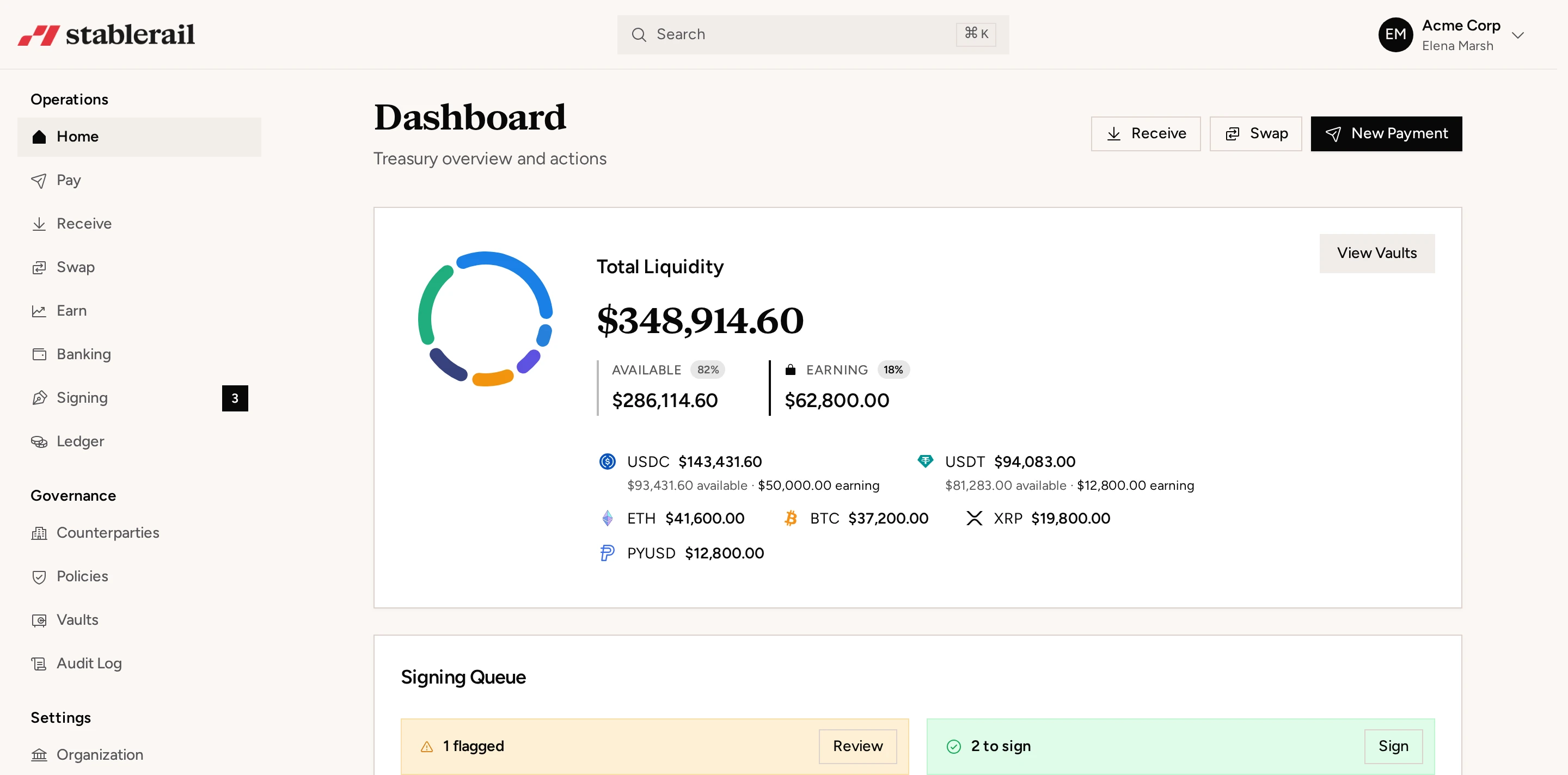
Handling withholding tax obligations for stablecoin payments can be tricky, especially when transactions settle on-chain. Stablerail simplifies this process by acting as a control layer between treasury decisions and transaction execution. Unlike traditional wallets that focus on storing and sending funds, Stablerail enforces governance standards similar to those used for bank wires. Here's how it ensures compliance at every step.
Policy-Driven Tax Compliance
Stablerail's policy-as-code engine translates your tax compliance rules into automated safeguards applied to every payment. For instance, you can set rules like "payments over $5,000 to new vendors require CFO approval and W-9 verification" or "cross-border transfers above $2,000 must go through a withholding review." These rules are enforced automatically, blocking non-compliant transactions before they can proceed.
This is especially critical as cost basis reporting for stablecoin transactions will become mandatory starting in 2026. Matthew May, CPA and co-founder of Acuity, highlights the importance of such controls:
"Internal controls for monitoring and tracking are a must. There will be a heavy emphasis on enterprise-grade tools... to monitor and record spot prices and transaction volume".
Stablerail also maintains a verified vendor whitelist to ensure payments only go to approved recipients. If a contractor's tax information changes or their wallet address is updated, the system locks the payment and escalates it for review. This prevents accidental payments to outdated or unverified accounts.
Pre-Sign Risk Screening for Tax Requirements
Stablerail builds on its policy-driven system with pre-sign risk screening to ensure every transaction complies with tax regulations. Before executing a payment, Stablerail's agents perform mandatory checks and create a Risk Dossier with a clear outcome: PASS, FLAG, or BLOCK. Each dossier provides detailed explanations, including the policy clauses triggered, timestamps, and reasons for additional scrutiny.
For tax compliance, the system screens wallet addresses against OFAC sanctions lists, verifies that required tax forms (W-9 or W-8) are on file, and confirms withholding calculations align with established policies. High-value payments or transfers to new recipients trigger automatic review delays, giving tax and compliance teams time to assess withholding obligations before funds are sent.
"Agents verify the intent. Humans sign the transaction." - Stablerail.
This "copilot, not autopilot" approach ensures that while the system flags potential tax issues, human approvers make the final decision with full context. By consolidating everything into one platform, Stablerail eliminates the need for juggling spreadsheets, Slack messages, and manual approvals.
Audit Trails for Regulatory Defense
Every step of a transaction in Stablerail - from intent creation to policy checks, approvals, and final signing - is logged in a comprehensive audit trail. This isn't just a list of transaction hashes; it includes detailed documentation like on-chain data, business justifications, approver identities, and valuation methods.
With the Canada Revenue Agency estimating an uncollected "tax gap" of approximately $20 billion annually and U.S. broker reporting now requiring Form 1099-DA for stablecoin transfers, such records are crucial. They provide the evidence needed to prove compliance and address any regulatory challenges.
Organizations must typically retain records of stablecoin transfers and valuation methods for five years. Stablerail's automated evidence packs include everything needed: transaction hashes, approval logs, tax policies applied, and market valuations. This ensures you can demonstrate "reasonable efforts" to comply and respond effectively to any Notice of Non-compliance.
Conclusion
Managing withholding tax obligations for stablecoin payments is no small feat. Since the IRS and most global tax authorities classify stablecoins as property rather than currency, every transaction becomes a taxable event. This means businesses must calculate capital gains or losses based on the fair market value in USD at the exact time of payment - whether paying employees, contractors, or vendors. These requirements demand precise internal controls and efficient processes to stay compliant.
Starting in 2026, the introduction of Form 1099-DA will add another layer of complexity. Businesses will need to report stablecoin transactions and maintain detailed, immutable audit trails that connect transaction IDs to invoices, contracts, or payroll records. While global tax approaches differ widely, frameworks like the OECD's Crypto-Asset Reporting Framework (CARF) and the EU's DAC8 are tightening the net, reducing opportunities for reporting discrepancies and enhancing transaction transparency. To keep up, businesses must adopt modern tools and strategies.
This is where tools like Stablerail come into play. By enforcing policy-driven tax compliance, Stablerail ensures that required tax forms (such as W-9 or W-8) are in place, withholding calculations are accurate, and wallet addresses are screened against OFAC sanctions lists before any transaction is processed. Every action, from initiating a transaction to final approval, is logged in a detailed audit trail. This gives finance teams the documentation they need to demonstrate compliance and address regulatory inquiries effectively.
To navigate these challenges, businesses should follow key practices: treat every stablecoin transaction as taxable, separate business funds into distinct wallets, record the USD fair market value at the exact time of each transaction, and use automated controls to ensure compliance before funds are transferred. With stablecoin trading volume projected to hit $23 trillion in 2024, managing withholding taxes correctly isn’t just important - it’s essential for businesses operating in this fast-changing environment.
FAQs
What stablecoin price source should I use for USD fair market value?
When dealing with stablecoin transactions, it's important to rely on the USD fair market value from a trusted source. This could be a reputable exchange or a well-known market data provider. Using a reliable reference ensures both accuracy and compliance, which are critical in maintaining transparency and trust in financial dealings.
How do I actually withhold tax when paying someone in stablecoins?
To handle tax withholding for stablecoin payments, treat these transactions as taxable events, just like other cryptocurrency dealings. Start by determining the fair market value of the stablecoins at the time of payment. Then, calculate the appropriate tax amount to withhold and report the payment on relevant tax forms, such as Form 1099-DA. Make sure to maintain thorough records of the transaction to comply with IRS requirements and to simplify any potential audits.
What records should I keep to defend stablecoin payments during an audit?
To ensure stablecoin payments hold up during an audit, it's crucial to maintain a thorough audit trail. This means documenting everything: the creation of intent, the checks conducted, any flags that were raised, overrides made, approvals granted, and the final signing process. Include detailed evidence, such as the rationale behind policies, precise timestamps, and records of human reviews. This level of documentation helps ensure transparency and compliance.
Related Blog Posts
Former CEO of Simple, a self-custodial wallet with $2B+ in transaction volume across 75+ countries.
More about the Stablerail team- Stablecoin treasury managementApprovals, limits, yield and reporting on one balance.
- Stablecoin payoutsBatch contractor and vendor payments with screening.
- USDT vs USDCWhich stablecoin your company should settle in.
- Stablecoin finance glossaryMPC, off-ramp, travel rule and the rest, in plain English.
- Product updatesEverything we ship, month by month.