
Stablecoin Risk Assessment Tool
A practical stablecoin risk assessment framework for CFOs and treasury teams, covering reserves, redemption, liquidity, compliance, blockchains, counterparties and controls.
A stablecoin risk assessment tool should evaluate more than price stability. Finance teams should review reserve quality, issuer transparency, redemption rights, liquidity, regulatory exposure, blockchain dependencies and internal transaction controls. Use current primary-source evidence, apply hard disqualification rules before scoring, set exposure limits by use case and monitor material changes continuously. A high score is not a guarantee against depegging, frozen funds or operational loss.

A stablecoin risk assessment should determine whether a token is suitable for a specific treasury purpose, not simply label it safe or unsafe. Start with hard requirements such as verified issuance, acceptable reserves, workable redemption and supported jurisdictions. Then score the remaining financial, legal, liquidity, technical and operational risks using current evidence. Approval should always specify permitted use cases, networks, counterparties, exposure limits and monitoring triggers.
Why stablecoin risk assessment matters
Stablecoins are designed to track a reference asset, commonly the US dollar, but the peg is only one part of their risk profile. A token can trade close to one dollar while still exposing a company to weak redemption rights, concentrated banking relationships, smart contract failures, sanctions risk or poor internal controls.
The relevant question for a CFO is therefore not, “Has this stablecoin held its price?” It is, “Can our company acquire, hold, move and redeem this asset under the conditions we are likely to face?” The answer may differ by entity, jurisdiction, blockchain and use case. A stablecoin acceptable for same-day supplier settlement may not be appropriate for storing a material share of operating cash.
Historical price charts remain useful, but they are backward-looking. They should be combined with issuer disclosures, reserve reports, legal terms, redemption procedures, market liquidity and operational evidence.
Stablecoin risk assessment criteria
The table below can serve as the core of a treasury assessment. Evidence should come from primary sources wherever possible and include the date reviewed, document owner and any unresolved questions.
| Risk area | What to assess | Evidence to collect | Warning signs |
|---|---|---|---|
| Stabilization mechanism | How the token maintains its target price and whether holders have a direct or indirect claim on backing assets. | Issuer terms, mint and burn process, token documentation and contractual structure. | Reliance on incentives, circular collateral or assumptions that fail during rapid selling. |
| Reserve quality | Asset types, maturity, liquidity, custody, concentration and whether reserves are segregated from operating assets. | Recent reserve disclosures, independent reports, financial statements where available and custodian details. | Opaque assets, long-duration or illiquid holdings, related-party exposure or unclear segregation. |
| Transparency | Frequency, scope and timeliness of reporting, including differences between an attestation and a financial statement audit. | Dated reports, reporting methodology, accounting firm information and reconciliation to circulating supply. | Stale reports, changing definitions, missing liabilities or claims that exceed the report's actual scope. |
| Redemption | Who can redeem, minimums, fees, processing steps, settlement method and circumstances in which redemption can be delayed or refused. | Issuer agreement, onboarding requirements and a documented test redemption through the intended account. | Access limited to intermediaries, unclear timelines, discretionary suspension rights or no tested fiat route. |
| Market liquidity | Ability to sell or exchange the expected amount without excessive price impact, including during stressed markets. | Order books and executable quotes across approved venues, on-chain pool depth and counterparty limits. | Volume concentrated on one venue, shallow liquidity, dependence on a single market maker or large spreads under stress. |
| Legal and regulatory exposure | Issuer structure, governing law, holder rights, permitted jurisdictions and treatment relevant to the company. | Legal terms, entity information, counsel's analysis and current regulatory notices. | Unclear issuer identity, prohibited use in an operating jurisdiction or ambiguous claims in insolvency. |
| Blockchain and contract risk | Supported networks, contract administration, upgrade controls, bridge dependencies, finality and operational history. | Official contract addresses, technical documentation, audit reports and administrator or pause authorities. | Unverified contracts, unnecessary bridges, concentrated admin keys or unsupported token representations. |
| Counterparty risk | Exposure to exchanges, custodians, banks, brokers and payout providers used around the stablecoin. | Contracts, account ownership, asset-handling model, withdrawal controls and concentration reports. | Commingled assets, unclear legal ownership, withdrawal dependence on one provider or excessive concentration. |
| Compliance risk | Sanctions controls, address screening, source-of-funds procedures and the issuer's ability to freeze addresses. | Compliance procedures, screening records, escalation rules and issuer terms. | No pre-transaction screening, unidentified counterparties or no process for frozen or rejected funds. |
| Internal operations | Wallet governance, approval segregation, signing quorum, address verification, reconciliation and incident response. | Approval logs, signer inventory, wallet register, transaction evidence and recovery procedures. | Single-person control, copied addresses without verification, shared credentials or incomplete accounting records. |
How to build a useful risk score
A single numerical score can help compare candidates, but it can also hide critical weaknesses. Use scoring only after applying non-negotiable eligibility gates. For example, a treasury team might reject any asset that lacks an identifiable issuer, current reserve evidence, an acceptable legal structure or a practical route to redemption. A strong liquidity score should not compensate for failure on one of those points.
For assets that pass the gates, assign each category a consistent internal rating, such as:
- 0 — unacceptable: evidence is missing or the risk exceeds policy.
- 1 — weak: material limitations exist and require mitigation.
- 2 — acceptable: requirements are met, with manageable residual risk.
- 3 — strong: evidence and controls exceed the minimum requirement.
Weight categories according to the intended use. Reserve and redemption risk may receive greater emphasis for balances held over time. Liquidity, network availability and counterparty execution may matter more for rapid global payouts. Document the reasoning rather than treating the final number as an objective market rating.
A risk score is a decision aid, not a prediction. Keep the underlying evidence, exceptions and approval conditions visible beside the score.
Match approval to the treasury use case
| Use case | Primary risks | Typical approval conditions |
|---|---|---|
| Short-duration payment transit | Execution, counterparty, network and recipient risk | Maximum holding period, approved network, screened recipient and confirmed off-ramp |
| Operating liquidity | Reserve, redemption, issuer and concentration risk | Balance cap, tested redemption, diversification and daily reconciliation |
| Cross-border payouts | Jurisdiction, recipient, off-ramp and chain-selection risk | Approved corridors, beneficiary verification, sanctions screening and proof of settlement |
| Trading or market operations | Venue, liquidity, collateral and intraday concentration risk | Approved venues, counterparty limits, withdrawal tests and escalation thresholds |
This use-based approach avoids a common mistake: approving a stablecoin globally when the evidence only supports a narrow workflow. USDC or USDT should also be assessed separately on every blockchain the company intends to use. Native issuance, bridged representations, transaction fees, finality and operational support can differ by network.
Finance-team assessment checklist
- Define the legal entity, jurisdiction, use case, expected balance, transaction size and holding period.
- Confirm the issuer and official contract address for each proposed blockchain.
- Collect current reserve, legal, redemption, technical and compliance evidence.
- Test acquisition, a small transfer and fiat redemption through the intended counterparties.
- Apply hard eligibility gates before calculating a comparative score.
- Set balance, counterparty, network and transaction limits in the approval record.
- Assign an owner and review date, then define events that require immediate reassessment.
Monitoring after approval
Approval is not permanent. Stablecoin risk changes when reserve composition changes, banking partners fail, issuer terms are revised, liquidity migrates, a blockchain is disrupted or regulators restrict access. Monitoring should combine scheduled reviews with event-driven escalation.
Useful triggers include a sustained deviation from the reference price, delayed redemption, a material change in reserve reporting, a contract upgrade, an issuer security incident, an address freeze affecting the company, deteriorating market liquidity or interruption at a critical exchange, custodian or off-ramp. Treasury should define who can pause new transactions, reduce balances or start an alternative redemption route.
The assessment record should preserve the evidence used for each decision. At minimum, retain report dates, source links, legal review, score changes, approval conditions, exceptions, wallet addresses and test-transaction results. This makes the process defensible to auditors and easier to repeat when conditions change.
Operational controls belong in the assessment
Even a well-backed stablecoin can be lost through an incorrect address, compromised signer or unsupported network. The assessment should therefore cover both the asset and the system used to control it. Require separation between transaction creation and approval, an appropriate signing quorum, verified address books, sanctions and address screening before send, and reliable accounting exports.
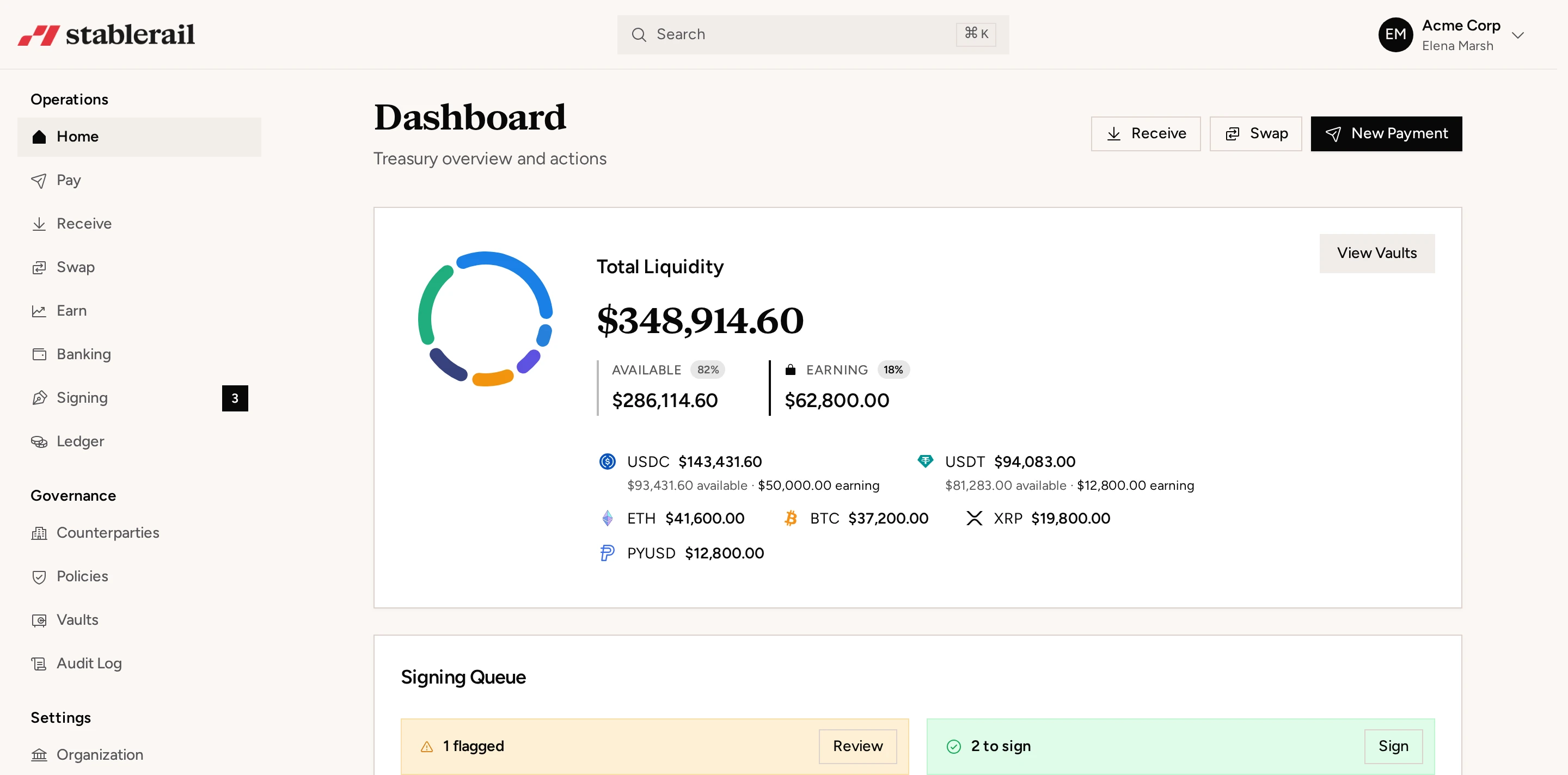
Stablerail brings USDC and USDT treasury activity into one business account with approvals and signing quorum, pre-send sanctions and address screening, corporate cards, global payouts, fiat off-ramp and exportable audit evidence. Regardless of platform, finance teams should verify that controls operate consistently across every wallet, network and payment route.
Limits of any stablecoin risk tool
No checklist or score can eliminate issuer failure, market stress, legal uncertainty, cyber incidents or human error. Public reports may be delayed, and contractual rights may differ from a user's assumptions. Treat the tool as a structured due-diligence record, validate important conclusions with legal and accounting advisers, and maintain a tested exit plan rather than relying on the peg alone.
Frequently asked questions
How do you assess the risk of a stablecoin?
Review the stabilization mechanism, reserve assets, issuer transparency, redemption rights, market liquidity, legal structure, blockchain dependencies and operational controls. Apply hard rejection criteria first, then score assets that meet the minimum requirements and approve them only for defined use cases.
What is the biggest risk with stablecoins?
There is no single biggest risk in every situation. For long-term holdings, reserve quality and redemption access may dominate; for payments, wrong-network transfers, counterparties, compliance and wallet controls can be more immediate threats.
How accurate is a stablecoin risk score?
A score is only as reliable as its evidence, methodology and review date. It can improve consistency and expose gaps, but it cannot predict depegging, issuer failure, regulatory action or operational loss, so hard eligibility rules and ongoing monitoring remain necessary.
How often should a company review stablecoin risk?
Set a scheduled review based on materiality and also reassess after significant events. Triggers should include reserve changes, revised issuer terms, redemption delays, contract upgrades, security incidents, regulatory restrictions or persistent price deviations.
Should USDC and USDT be assessed separately on each network?
Yes. The issuer relationship may be similar across networks, but contract addresses, native versus bridged issuance, finality, fees, administrator controls and operational support can differ. Approval should name the exact token contract and blockchain rather than the ticker alone.
Can a stablecoin risk assessment replace legal or financial advice?
No. It structures evidence and supports internal decisions, but it does not determine accounting treatment, legal rights, tax consequences or regulatory obligations. Material exposures should be reviewed with qualified legal, accounting and compliance advisers.
Former CEO of Simple, a self-custodial wallet with $2B+ in transaction volume across 75+ countries.
More about the Stablerail team- Stablecoin treasury managementApprovals, limits, yield and reporting on one balance.
- Stablecoin payoutsBatch contractor and vendor payments with screening.
- USDT vs USDCWhich stablecoin your company should settle in.
- Stablecoin finance glossaryMPC, off-ramp, travel rule and the rest, in plain English.
- Product updatesEverything we ship, month by month.