
Stablecoin Payment Risk Calculator
Use a practical scoring model to assess USDC and USDT payments by asset, counterparty, jurisdiction, transaction, execution and operational risk.
A stablecoin payment risk calculator helps finance teams decide whether to approve, escalate or reject a transfer by scoring the asset, counterparty, jurisdiction, transaction pattern, blockchain execution and internal controls. It should identify specific risk drivers rather than imply that one score guarantees safety. For material USDC or USDT payments, combine the result with address screening, approvals, wallet verification, liquidity checks and documented legal review.

A stablecoin payment risk calculator helps finance teams decide whether to approve, escalate or reject a transfer by scoring the asset, counterparty, jurisdiction, transaction pattern, blockchain execution and internal controls. It should identify specific risk drivers rather than imply that one score guarantees safety. For material USDC or USDT payments, combine the result with address screening, approvals, wallet verification, liquidity checks and documented legal review.
What a stablecoin payment risk calculator should measure
A useful calculator evaluates more than the historical price stability of a token. Stablecoin payments can fail or create losses even when the asset continues trading at its intended value. Funds may be sent over the wrong network, transferred to an incorrect address, delayed by internal approvals, received from a sanctioned address or become difficult to reconcile against an invoice.
For business payments, the assessment should cover six connected risk categories:
- Asset and issuer risk: The stablecoin's reserve structure, redemption mechanism, issuer terms, concentration of liquidity and ability to freeze or block tokens.
- Counterparty and address risk: The identity of the payer or recipient, ownership of the wallet, sanctions exposure and links to suspicious onchain activity.
- Jurisdiction risk: The locations of each legal entity, restrictions on crypto activity and the regulatory treatment of the payment.
- Transaction risk: The amount, purpose, frequency, commercial documentation and whether the behavior differs from the counterparty's normal pattern.
- Execution risk: The blockchain network, token contract, destination address, network fees, congestion and finality requirements.
- Operational risk: Wallet permissions, approval thresholds, signing quorum, reconciliation, record retention and incident response.
These categories should remain visible in the result. A single composite score is convenient, but it can conceal a critical issue. A low-risk asset does not compensate for a sanctioned recipient, and a familiar supplier does not make an unsupported network safe to use.
A practical scoring model
Finance teams can score each category from 1 to 5, where 1 represents limited identified risk and 5 represents an unacceptable or unresolved condition. The rating should combine the likelihood of a problem with its potential financial, legal and operational impact. Weightings can then reflect the company's risk appetite and payment profile.
| Risk category | Lower-risk indicators | Higher-risk indicators | Evidence to review |
|---|---|---|---|
| Asset and issuer | Approved stablecoin, supported redemption route and adequate market liquidity | Unclear issuer rights, weak liquidity or recent loss of price stability | Issuer terms, reserve reporting, approved asset list and liquidity quotes |
| Counterparty and address | Verified legal entity and wallet ownership with clean screening results | Unknown owner, indirect payment request or sanctions and illicit-finance exposure | Onboarding records, wallet attestation, invoice and address-screening report |
| Jurisdiction | Reviewed payment corridor with established internal guidance | Restricted location, unclear legal treatment or conflicting entity locations | Entity records, legal analysis and current sanctions requirements |
| Transaction | Expected amount and purpose supported by a contract or invoice | Unusual size, urgency, frequency, split payments or changed instructions | Invoice, purchase order, approval record and transaction history |
| Execution | Confirmed network, validated token contract and tested destination | New network, copied address from an unverified channel or unsupported bridge | Network details, allowlist record, test transfer and transaction hash |
| Operations | Segregated roles, quorum approval and complete reconciliation | Single-person control, shared credentials or missing accounting records | Approval log, signer record, ledger entry and audit export |
A simple calculation is to multiply each category's rating by its assigned weight and add the results. However, certain conditions should override the numerical score. A confirmed sanctions match, an unverified destination address, a prohibited jurisdiction or a token-network mismatch should stop the payment until resolved.
The thresholds must be set by the business rather than copied from a generic template. A treasury team making recurring intercompany transfers will have a different risk appetite from a marketplace paying newly onboarded recipients. Define what qualifies for straight-through approval, manual review, executive approval and rejection before the calculator is used.
How USDC and USDT risks differ from price volatility
USDC and USDT are designed to track the US dollar, but that does not make a payment equivalent to a bank transfer or insured cash deposit. The finance team still depends on the issuer, the relevant token contract, blockchain availability and access to exchanges, banking partners or redemption channels.
Both stablecoins exist on multiple networks. The same ticker can therefore refer to tokens with different contract addresses and technical requirements. Sending a supported token over an unsupported network can leave the recipient unable to credit or access the funds. A payment review should confirm the stablecoin, blockchain, token contract and recipient address as separate fields.
Liquidity also depends on the intended exit route. A token may trade actively in aggregate while offering limited liquidity through the company's approved venue, local currency pair or banking corridor. For a payment that will be converted into fiat, evaluate the full route from wallet receipt through conversion and bank settlement, including fees, spreads, cut-off times and required documentation.
Counterparty and address screening
Country selection alone is not enough to determine regulatory risk. The payer, recipient, beneficial owners, wallet address, transaction purpose and flow of funds may all matter. Regulatory requirements also change, so a static list of friendly or unfriendly countries can quickly become misleading.
Before sending, verify the counterparty through an independently established communication channel. Payment instructions received only through email or chat should be treated carefully, particularly when an existing supplier suddenly changes its wallet address or requested network.
Screen the destination address before execution and retain the result with the payment record. Screening can identify sanctions exposure or connections to risky activity, but it is not a guarantee that an address is safe. Results require documented review, especially when exposure is indirect, data is incomplete or the counterparty uses a hosted wallet.
Transaction size, frequency and behavior
A large payment is not automatically suspicious, and many small payments are not automatically safe. Risk comes from context. Compare the proposed transfer with the contract, invoice, counterparty profile and previous activity. A first payment, a material increase, repeated transfers just below an approval threshold or a request to divide one invoice across several wallets should trigger additional review.
Frequency also affects operational exposure. Recurring payments create more opportunities for address substitution, duplicate settlement and reconciliation errors. Approved beneficiary records, invoice matching and duplicate-payment checks are therefore as important as blockchain analytics.
Pre-send checklist for finance teams
- Confirm the commercial purpose. Match the amount, currency and beneficiary to an approved invoice, contract or treasury instruction.
- Verify the recipient. Confirm the legal entity and wallet ownership through a trusted channel, especially after any change in instructions.
- Validate the transfer route. Check the stablecoin, network, token contract, address format and whether the recipient supports that exact combination.
- Screen before sending. Review sanctions and address-risk results close to execution time and document any escalation.
- Apply approval controls. Use role separation, transaction limits and the required signing quorum. Do not allow the preparer to approve alone.
- Test when appropriate. For a new beneficiary or network, send a controlled test amount and confirm receipt before releasing the balance.
- Plan fees and liquidity. Ensure the wallet can pay network fees and confirm the recipient's conversion or redemption route if fiat is required.
- Preserve evidence. Save approvals, screening output, wallet details, invoice references and transaction hashes for reconciliation and audit.
What the risk score cannot tell you
A calculator provides structured triage, not a legal opinion or prediction of loss. It cannot guarantee the issuer will maintain redemption, a blockchain will remain available, a screening provider has identified every relevant exposure or a jurisdiction's rules will remain unchanged. Data quality also matters: incorrect counterparty information will produce a misleading result.
The output should therefore explain why a payment received its rating and which controls could reduce the risk. For example, an unknown wallet might move from unresolved to reviewable after ownership verification and screening. A network mismatch cannot be mitigated with extra approval; the payment instructions must be corrected.
Turning assessment into treasury control
The strongest process connects assessment, execution and accounting. If teams calculate risk in one system but approve and send from an uncontrolled wallet, the score has limited value. Payment data should flow into a clear record containing the preparer, approvers, signers, destination, amount, asset, network, screening result and transaction hash.
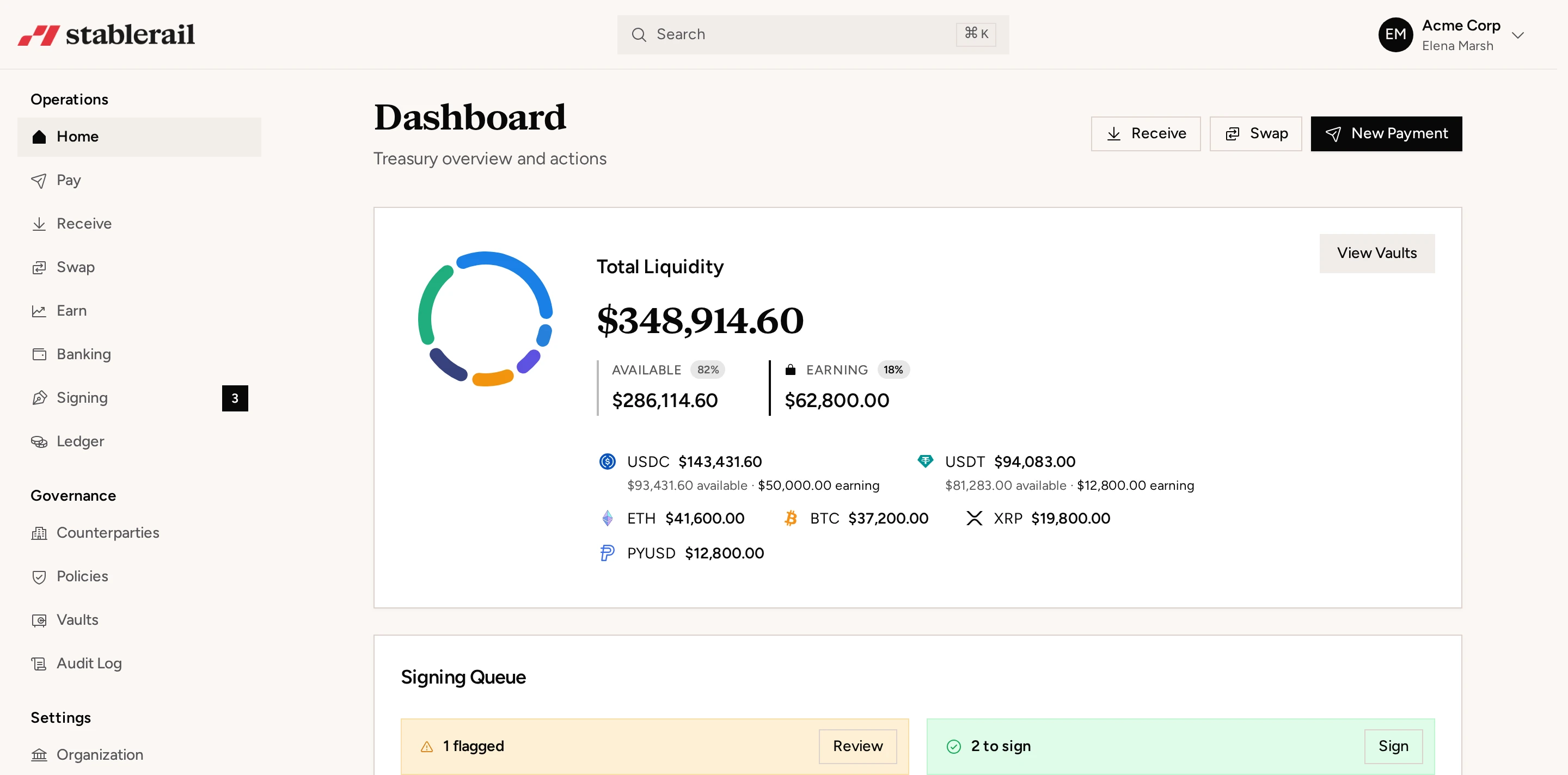
Stablerail supports this workflow through one business account for USDC and USDT treasury, with approvals and signing quorum, sanctions and address screening before send, global payouts, corporate cards, fiat off-ramp and exportable audit evidence. Whatever platform is used, the control objective is the same: no material transfer should rely on one person's judgment or leave finance reconstructing evidence after the fact.
Review scoring assumptions regularly and after any incident, new stablecoin, blockchain, jurisdiction or payout type. A calculator is most useful when it functions as a living control framework: transparent enough for operators to follow, strict enough to stop unresolved payments and documented well enough for controllers, auditors and executives to understand the decision.
Frequently asked questions
How do you calculate the risk of a stablecoin payment?
Score the asset, counterparty, jurisdiction, transaction, execution route and internal controls, then apply weights based on your risk appetite. Keep hard-stop conditions such as a sanctions match, unverified destination or network mismatch outside the weighted score so they cannot be averaged away.
Are USDC payments safer than USDT payments?
Neither token is universally safer for every payment. The answer depends on issuer and redemption risk, the blockchain used, liquidity through your approved venues, the receiving party's support and your operational controls.
What should be checked before sending stablecoins to a supplier?
Verify the supplier's legal identity and wallet ownership, then confirm the token, network, contract address and destination. Screen the address, match the payment to approved documentation, apply the required signing quorum and retain the transaction hash and approval evidence.
Can blockchain address screening guarantee a payment is safe?
No. Screening can identify sanctions exposure and links to risky onchain activity, but coverage and attribution are not perfect. Finance teams should review the result alongside counterparty due diligence, payment purpose and independently verified wallet ownership.
Should a business send a test stablecoin transaction first?
A controlled test transfer is often appropriate for a new beneficiary, wallet or blockchain route. Confirm receipt of the exact token on the intended network before releasing the remaining amount, while still applying normal approvals and screening to both transfers.
Former CEO of Simple, a self-custodial wallet with $2B+ in transaction volume across 75+ countries.
More about the Stablerail team- Stablecoin treasury managementApprovals, limits, yield and reporting on one balance.
- Stablecoin payoutsBatch contractor and vendor payments with screening.
- USDT vs USDCWhich stablecoin your company should settle in.
- Stablecoin finance glossaryMPC, off-ramp, travel rule and the rest, in plain English.
- Product updatesEverything we ship, month by month.