
Stablecoin Payment Risk Analyzer
Evaluate stablecoin payment risk across the asset, blockchain, jurisdiction, counterparty and transaction size. Learn how to interpret the score, verify its inputs and apply proportionate treasury controls.
A stablecoin payment risk analyzer helps a business identify the main risks of accepting or sending stablecoins before funds move. It evaluates factors such as the stablecoin, blockchain, jurisdiction, counterparty and transaction size, then highlights where stronger controls may be needed. The result is a triage tool—not a guarantee of safety—and should be supported by address screening, counterparty checks, approval controls and documented evidence.

What a stablecoin payment risk analyzer should tell you
A stablecoin payment risk analyzer turns a proposed transaction into a structured risk assessment. Instead of treating every USDC, USDT or other stablecoin transfer as equally safe, it asks which asset will move, on which blockchain, between which parties, under what legal conditions and for what amount.
The output is most useful as an initial risk classification. A low score may indicate that the information entered does not reveal obvious concerns. It does not prove that the wallet is legitimate, the stablecoin will maintain its value or the transaction complies with every applicable rule. A high score is a prompt to investigate, add controls or decline the payment—not proof that the transaction is illicit.
This distinction matters because stablecoin risk is not one problem. It is a combination of asset, network, counterparty, compliance, operational and liquidity risks. A useful analyzer separates those components so a finance team can see what is driving the result.
The factors that determine stablecoin payment risk
| Risk factor | Question to answer | Evidence to review | Possible control |
|---|---|---|---|
| Stablecoin | Who issues it, what supports it and how can it be redeemed? | Issuer terms, reserve disclosures, redemption conditions and supported jurisdictions | Restrict treasury activity to approved assets and set exposure limits |
| Blockchain | Is the token on the intended network, and can the business operate that network safely? | Token contract, chain identifier, wallet support and required network fees | Allowlist approved token-and-chain combinations and test new routes |
| Counterparty | Who controls the sending or receiving address? | Legal name, wallet ownership evidence, invoice, contract and payment instructions | Verify counterparties and independently confirm address changes |
| Address exposure | Does the address present sanctions or other illicit-finance concerns? | Timestamped screening result and investigation notes | Screen before sending or crediting funds, with escalation for alerts |
| Jurisdiction | Which laws, restrictions and reporting duties may apply? | Entity location, customer location, transaction purpose and legal guidance | Define permitted and restricted corridors with compliance counsel |
| Transaction size | How large is the transfer relative to normal activity and available liquidity? | Invoice amount, transaction history, treasury balance and approval record | Apply higher approval thresholds or split operational exposure where appropriate |
| Liquidity and off-ramp | Can the business convert or redeem the stablecoin when needed? | Supported conversion route, banking details, cut-off constraints and fees | Confirm the off-ramp before accepting material balances |
| Operations | Could an address, signing or reconciliation error cause a loss? | Approval logs, wallet permissions, test transaction and ledger records | Use dual approval, signing quorum and independent reconciliation |
How to interpret the risk score
If the analyzer produces a score from 0 to 100, treat it as a ranking generated from the submitted answers—not as the statistical probability of loss. The result depends on the scoring weights, the quality of the inputs and how current the underlying information is. A simple questionnaire cannot inspect a wallet’s transaction history, confirm beneficial ownership or determine the legal treatment of a payment by itself.
The score should therefore be accompanied by a factor breakdown. For example, a transfer may receive a higher result because the counterparty is unknown, the jurisdiction requires further review or the amount is unusually large. Those drivers are more actionable than the headline number because they tell the reviewer what must be resolved.
Historical price behavior can provide context, but it should not be treated as a complete measure of stablecoin quality. An illustrative or mock volatility input is not live market data. It also cannot assess reserve composition, redemption access, issuer restrictions, token contract risk or whether liquidity is available on the specific chain being used.
Decision rule: use the score to determine the depth of review, then make the payment decision from verified evidence and approved policy.
Different payment types create different risks
The same stablecoin can present a different risk profile depending on how it is used. Receiving a customer payment, paying a vendor and holding treasury reserves should not share one undifferentiated approval process.
| Use case | Main risk | Finance team priority |
|---|---|---|
| Customer payment | Unknown wallet origin, incorrect payment amount or payment on the wrong network | Issue precise instructions, screen the address and reconcile the on-chain transfer to the invoice |
| Vendor payout | Fraudulent address substitution or payment to an unapproved party | Verify wallet ownership, confirm changes through a separate channel and require approvals |
| Payroll or contractor payout | Recipient eligibility, tax treatment and failed payment instructions | Collect consent and payment details, validate the corridor and retain payroll evidence |
| Treasury holding | Concentration, depegging, redemption or issuer exposure | Set asset and counterparty limits and maintain a documented exit route |
| Fiat off-ramp | Conversion delays, unsupported asset-chain pairs or mismatched account ownership | Confirm route availability, account names and settlement steps before funds arrive |
A practical pre-payment checklist
- Identify the legal parties. Record the sender, recipient, purpose of payment and relevant contract or invoice.
- Confirm the asset and network. Verify the stablecoin, token contract and blockchain rather than relying on a ticker symbol alone.
- Verify wallet ownership. Obtain the address through an approved channel and independently confirm new or changed instructions.
- Screen the address. Complete sanctions and address screening close to the time of the transfer, and document the result.
- Assess jurisdiction and purpose. Check that the corridor, counterparty type and transaction purpose are permitted under company policy.
- Set the approval level. Route larger, unusual or higher-risk transactions to additional reviewers.
- Check execution details. Confirm available network fees, decimal precision, destination compatibility and any required reference information.
- Retain evidence. Save approvals, screening results, transaction hash, invoice, exchange-rate record and accounting entry.
For a new address or chain, a small test transfer can reduce operational error, but it does not establish that a counterparty is compliant or trustworthy. The test confirms routing and access; due diligence must still be completed separately.
Controls that matter after the assessment
Separate preparation, approval and signing
The person creating a payment should not be able to complete a material transfer without review. Approval workflows and signing quorum reduce dependence on one employee or device. Access should also be removed promptly when responsibilities change.
Screen before funds move
Address risk can change as new on-chain activity occurs or screening information is updated. Screening should happen near execution rather than only when a counterparty is onboarded. Alerts require documented investigation; an automated flag should not be cleared without a reason.
Control the asset-and-chain combination
Stablecoins with the same ticker can exist on multiple networks, and unsupported tokens may be difficult or impossible to recover. Maintain an approved list that includes the issuer, token contract and blockchain. Payment instructions should identify all three where relevant.
Plan conversion and reconciliation
A completed blockchain transfer is not the end of the accounting process. Finance must match the transaction to the invoice, record fees and exchange rates consistently, and document any difference between the invoiced and received amounts. If fiat is needed, the conversion and bank settlement route should be confirmed in advance.
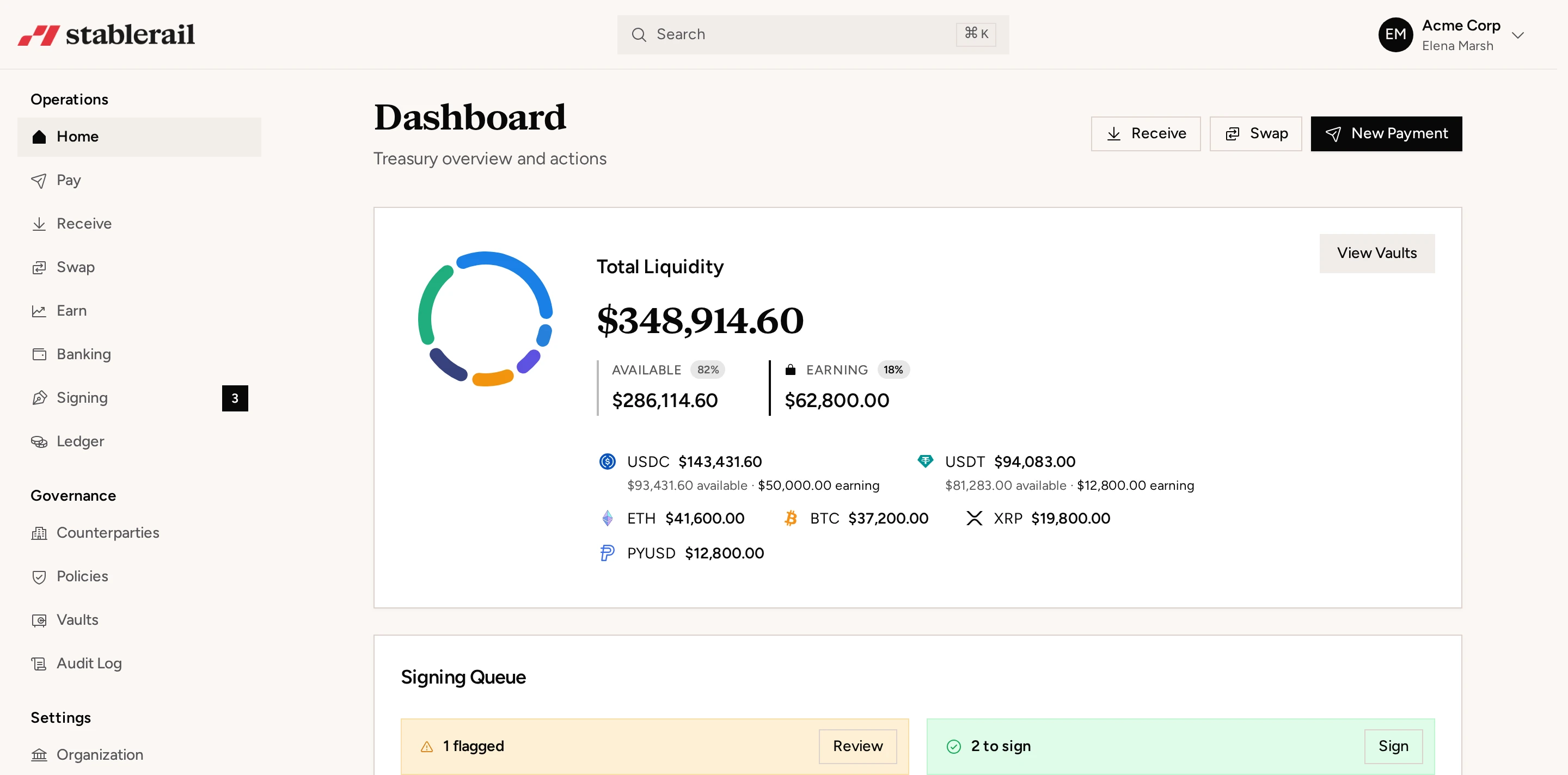
A business account such as Stablerail can bring USDC and USDT treasury activity into one operating environment with approvals and signing quorum, sanctions and address screening before send, global payouts, fiat off-ramp and exportable audit evidence. Whatever system is used, the control objective is the same: no material transfer should depend on an unverified address, a single approver or evidence assembled after the fact.
What the analyzer cannot decide for you
A risk analyzer is not legal advice, a blockchain investigations report or a substitute for treasury policy. Jurisdictional rules can depend on the legal entities involved, the role the business performs, the customer relationship and the specific flow of funds. Seek qualified advice when entering a new market or offering a new payment product.
It also cannot eliminate stablecoin-specific financial risk. A token designed to track the US dollar may trade away from its target, face redemption constraints or become less liquid on a particular network. Treasury teams should consider both the probability of disruption and the amount the company could have exposed when it occurs.
Turn the result into a documented decision
The best use of a stablecoin payment risk analyzer is to make review consistent. Record the inputs, preserve the factor breakdown and link the result to a clear action: proceed, proceed with additional controls, escalate or decline. Reassess when the counterparty changes its address, the business uses a new blockchain, the transaction becomes materially larger or the legal and operational context changes.
A score starts the conversation. Verified counterparties, screened addresses, controlled signing, reliable reconciliation and accessible audit evidence are what make stablecoin payments operationally defensible.
Frequently asked questions
How does a stablecoin payment risk analyzer calculate risk?
It assigns weight to inputs such as stablecoin type, blockchain, jurisdiction, counterparty and transaction size, then combines them into an overall score or category. The factor breakdown is more useful than the number alone because it shows which concerns require investigation or additional controls.
Can a risk score prove that a stablecoin payment is safe?
No. A score reflects the information supplied and the analyzer’s methodology; it cannot guarantee wallet ownership, legal compliance, stablecoin liquidity or the absence of illicit activity. Use it as triage alongside address screening, counterparty verification and payment approvals.
What should a business check before accepting USDC or USDT?
Confirm the issuer-backed token and blockchain, verify the customer and sending address, assess applicable jurisdictional requirements, and make sure the business can custody and convert the asset. Finance should also define how the receipt will be screened, valued, reconciled and recorded.
Does a small test transaction reduce stablecoin payment risk?
A test transfer can confirm that the address, network and wallet access work as expected. It does not verify the counterparty’s identity, establish the source of funds or protect against later address substitution, so normal due diligence and approval controls still apply.
How often should stablecoin counterparties and wallet addresses be reviewed?
Review them at onboarding and again when payment details, ownership, transaction patterns or jurisdictions change. Address screening should also occur close to each transfer because on-chain exposure and screening information can change after onboarding.
Former CEO of Simple, a self-custodial wallet with $2B+ in transaction volume across 75+ countries.
More about the Stablerail team- Stablecoin treasury managementApprovals, limits, yield and reporting on one balance.
- Stablecoin payoutsBatch contractor and vendor payments with screening.
- USDT vs USDCWhich stablecoin your company should settle in.
- Stablecoin finance glossaryMPC, off-ramp, travel rule and the rest, in plain English.
- Product updatesEverything we ship, month by month.